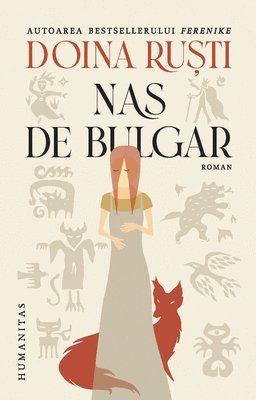
Nas de bulgar (Bulgarian Nose): Reviews and
Doina Ruști’s recent novel, Nas de bulgar, has gathered opinions, reading impressions, reviews, and comments.
As in Ferenike, here too reality and the fantastic subtly intertwine through a journey that begins in communism and leads toward ancient worlds.
Below I have collected opinions signed by Dan C. Mihăilescu, Roxana Dumitrache, Petre Nechita, Emma Neamțu, as well as from the Ești în cărți book club, run by students at Ferdinand I College in Bacău.
Critical Reception
You remembered well, dear lady reader, when you saw the writer’s name on the cover. Yes, this is the same Doina Ruști who delighted you — and us — in The Ghost in the Mill (2008), with her introspective gift for entering the world of childhood, of femininity budding in an innocence outraged by the cruelty of history and the injustice of fate; then with the sensory-fantasmatic lacework of the Phanariot trilogy, composed of Homeric, The Book of Perilous Dishes, and The Phanariot Manuscript; as well as with the raw and endearing delicacy of Lizoanca at the Age of Eleven, or the endearing and sarcastic tone of Mămica la două albăstrele. The writer feels in a Proustian manner, yet describes in a Balzacian one, masterfully cultivating psychological mosaic-work and behavioral color.
And you, dear gentleman reader, will have recognized on the cover the name of the writer who gave us the exuberant Balkanism of Zogru (2006), and the seductive genealogical casebook of Ferenike (Humanitas, 2025), where the mediumistic soul of the ten-year-old girl incorporates the entire family tree, with the Father haloed like a god in a ghostly retrospective, only to end as a sacrificial victim.
Nas de bulgar takes the little girl from Ferenike into high school and university, turns the family chronicle into a campus novel — Dormitory no. 6 of the University of Iași — with Arab students trafficking in everything and serial rapists; it gratefully displays the qualities of teachers such as Adelina Piatkowski and Cicerone Poghirc, outrages us with Securitate harassment, yet also provokes exotic visions through its incursions into illo tempore and the southern Danubian world, including Alexander the Great, Goths, Thracians, Visigoths, and certain Montenegrin Vlach ancestors, knights born with a spear in hand.
A complete spectacle of realism and fantasy, with chimerical loves, vulnerable innocence, and histrionic egocentrism; the village of Comoșteni neighbors García Márquez’s Macondo, while time contracts like the bellows of an accordion. This first diptych of an autofictional tetralogy displays the contents of the drawers from which all the writer’s previous books have emerged, offering us, in the former student’s fascination with Gaston Bachelard’s elemental reveries, the surest key to deciphering her mysteries. With sight in Ferenike and smell in Nas de bulgar, we may wait with trembling anticipation for the next volume, perhaps devoted to hearing as listening.
Dan C. Mihăilescu
An enveloping, cinematic, dense saga, in which cruel history intersects with the subjective history of the narrator-protagonist and holds you captive in a kaleidoscopic story about fantastical characters, untamed spirits such as the zuli, myths more or less diffuse, evoking unknown parts of archaic history, mythological proximities, but also major social themes such as the condition of women and of migrants.
After the formidable novel Ferenike, Nas de bulgar continues the archaeology of identity meant to complete an anti-pantheon, a gallery of personal demons — this time with the demon of love in the foreground.
Although symbolically tied to the history of Romanians through its eleven episodes, the love story, evoked with tender humor, intelligent candor, and populated by eclectic literary references, remains self-contained and claims its right to exist.
There is no such thing as a time after history, just as there can be no time after love, because every love is probably meant to place a halo over the world.
Nas de bulgar is about past and nearby worlds, but also about the way love solarizes them.
Roxana Dumitrache
The novel is a personal history, but from the particular it passes, naturally and without stumbling, into the general, the universal. It is our history, the history of the people south and north of the Danube, the history of blood — one told more clearly than in any school textbook.
Nas de bulgar is a love story, a history of the self, of self-love, but also a novel of the culprit in the shadows and of unheard, ignored victims. A book about migration, about flight and return. The novel represents a personal history that leads us toward the general. After the childhood of Ferenike, in Nas de bulgar we move on to the high-school and university years, in the City of White Skins, during the communist period.
But this personal history is connected to past generations, and thus we descend through time, all the way back to Alexander the Great.
No digressions, no pompous, inflated passages designed to become quotations.
“And in my blood there has always moved a shadowy story, beneath which tribes and families of travelers scatter.”
As in Ferenike, what astonishes is the exactness of memory. Let us be clear: the two novels are not diaries, but they give the impression of having been written at the very moment when the events took place, yet with the dose of wisdom granted by the passage of time. One observation should be added here. Do not look for metaphors in Doina Ruști — not in Ferenike and Nas de bulgar. Do not imagine that when she says I remember that year in detail, it is an exaggeration. Read directly; go to the proper, real core of the expression; do not hunt for horoscope-style interpretations. The City of White Skins is the city of people without features, shaped from a transparent film. Exactly so, nothing more and nothing less.
Petre Nechita, Ficțiunea
Obviously, the contemporary part of the personal history was written with retrospectively exploratory intentions, yet it is also read as a document of the era — the 1970s — with all its schizoid manifestations, captured and rendered by the writer in all their absurdity, with humor and acidity, with rebellion, without conformist intentions: the Worm, the teachers, the readings, the studies, the dormitory, the crimes and rapes, the greyness, the exasperation. The swamp in which she refuses to lose herself. The solitude she seeks and protects, a border between herself and the others. Merciless lucidity.
What must be noted is the utterly special nature of the reality in which the protagonist lives. Several times, she observes that the interlocutor of the moment mistakenly takes her words as metaphors or symbols, when in fact, for her, they represent the most objective truth. That is why, in this novel, the ancient stories, from Detustaina to Veliku, from gods to zuli, although composed or reconstructed by the protagonist, are as real as if she had seen them with her own eyes, and they intertwine organically with the rest of her universe. Based on real events, to use a familiar phrase, they are at the same time free enough to form an authentic and deeply personal mythology. They are coordinated by the same deep and lucid knowledge of human nature, of the impulses, emotions, and desires that determine destiny. That is why, moreover, there is no point in separating reality from fiction in the narrator’s account, because for her, everything she tells has happened — to her or to her ancestors — and that is all that matters.
Emma Neamțu, Bookhub
“Love means discovering who you are.”
If, in the writer’s previous universe — the one shaped around the setting of Comoșteni in the novel Ferenike — the “demon of death” reigned sovereign and merciless, in this new narrative world we become fascinated witnesses to the absolute triumph, or perhaps the total enslavement, imposed by the demon of love. This devouring force reconfigures destinies and rewrites the characters’ priorities. The turning point of the entire existential journey, the axis around which the protagonist’s whole evolution revolves, is marked by the hypnotic encounter with “the Model” on Pushkin Alley. This confrontation is not a simple crossing of two gazes, but the disturbing encounter with that “monster that turns you into a slave and from which no one escapes.” Love thus loses its idyllic attributes and takes on the dimensions of a mythical force, an implacable destiny that claims its rights and which, through the spiritual bondage it imposes, paradoxically becomes the only authentic path toward freedom and self-knowledge.
Personal trauma and national myth are explored in depth, presented as two inseparable sides of the same existential coin. In a downright fascinating parallel, the oppressive universe of communism and distant archaic history are depicted as complex systems of control, which nevertheless offer, paradoxically, unexpected paths of spiritual escape. Amid this tangle of constraints, there also appear benevolent figures of authority, such as Professor Badea. Although governed by undeniable academic severity, he knew how to look indulgently “through his eyelashes” and “over his glasses,” guiding with tact the young, rebellious spirit toward a world of ideas he believed to be perfect. Through the rigorous study of Latin and through intellectual discipline, the characters attempt to distill the wanderings specific to youth, hoping to reach the pure essence of their being.
Doina Ruști’s novel reflects a dense literary space, where the aromas of the Danube mingle painfully with the hidden suffering of the aquatic world, and where the winding road toward the self necessarily passes through the “open door” of the other. Nas de bulgar remains a disturbing story about the way we reconstruct our fragmented identity in the mirror of the beloved, all unfolding under the discreet patronage of ancient gods and of a great history that never releases us from its grip.
Amalia Pascaru, Ești în cărți
Some books have a profound impact on the self because they carry you into a universe where you feel at home—a home of the heart, which recognises the place where it gathers its energies. One such novel is Doina Ruști’s A Bulgarian Nose, published by Humanitas. From its very first pages, the novel welcomes you fully into its world, opening its gates and inviting you to settle in comfortably and savour the joy of remembrance and the wisdom acquired over the years. This is especially true if you are already familiar with the characters from reading Ferenike. You know who Muc, Gică, Mițulica and Cornel are; you know which events shaped the protagonist’s life and how they were reflected in her consciousness; you know the dreams and stories that marked her childhood.
A Bulgarian Nose naturally offers both a panoramic and a detailed view of her school years, particularly the tenth grade and her first year at university—significant years that laid the foundations of her development, years of revelation and self-discovery through love. On the one hand, we learn the protagonist’s life story, with all her quests, revelations and experiences; on the other, we uncover details of a personal history, of a vanished yet still living world, with migrations, escapes, battles and magnetic attractions—with Bandula, Veliku, white birds, hooded figures, Vlachs and fierce conflicts that complete the map of her identity. [...]
The novel explores themes such as love, identity and Balkanism in a way that leaves a lasting imprint on the reader’s memory. The story flows like a torrent from which the emotions that engender it continually emerge. Love is the driving force behind the discovery of the self, of identity and of one’s place in the world—in the Balkan space, both objectively and, above all, subjectively. [...]
Reading this wonderful novel is like embarking on a journey. From its opening pages, the book captivates through the way it constructs a universe that we quickly come to feel is ours. It is a universe that steals us away, holds us captive and sets us free at the same time, revealing facets of existence in a unique manner. It unveils the enduring beauty of the soul and invites us into unforgettable times: the adolescence and youth of the narrator-protagonist, who experiences every step and every event intensely, searching for her bearings and her miracles. The novel fascinates us not only through its inventive, vibrant narrative style, but also through its love story, rich in identities and magic.
The novel also portrays an era, a memorable time now past, which retains its distinctive fragrance and leaves its traces upon a being thirsting for freedom.
The novel is inseparable from the elements that have become Doina Ruști’s hallmark: pages of history, a fantastic imaginary, abundant humour and even a scholarly touch provided by skilfully handled literary references.
Serenela Ghițeanu, Revista 22
The Greek myths lose their textbook solemnity and become living stories, viewed with critical intelligence and an evident solidarity with the women whom history and literature have reduced to mere victims.
The episode of the Thracian king Tereus, who raped his sister-in-law—an episode narrated with an oral quality, humour and indignation—reveals much about the way the protagonist reads the world. Beneath the anecdote and conversational tone lies a serious reflection on abuse, power and the way history has often chosen to speak about aggressors while leaving their victims in the shadows.
A Bulgarian Nose is, in equal measure, a declaration of love addressed to culture.
Music appears at almost every turn. The school choir, the Conservatory, Philharmonic balls, student evenings at the Pushkin, Queen, Pink Floyd, Santana, ABBA and Smokie compose the soundtrack of a generation trying to breathe beyond the borders of communism. “Of all the arts, music takes me out of myself.” (Doina Ruști, A Bulgarian Nose, p. 111). This sentence perhaps best explains the way art functions in the novel: as an escape from the confines of immediate reality. The same is true of literature. One of the most beautiful scenes is the discovery of Nicolae Breban’s novel Sick Animals. “In Breban, there was living flesh cut by a blade; you could hear the cries and the smell of blood lingered in your nostrils.” (Doina Ruști, A Bulgarian Nose, p. 167).
Books and libraries are, in fact, constantly evoked. One of the most moving passages describes a hidden library in a provincial town, where old books and rare editions are preserved almost clandestinely, for fear of ignorance and neglect. Beyond its delightful narration, the episode speaks about the status of the book in a world that values it and threatens it at the same time.
For Doina Ruști, literature is never merely narrative composition, but a cultural labyrinth and a means of survival.
Ligia Pârvulescu, Catchy
A Bulgarian Nose is far more than a story about communism or a character’s coming of age. The more distant past continually enters the narrative, while myth and history mingle with personal memory. This is one of the things I have appreciated most about Doina Ruști: the way she can begin with a memory, a person or a place and, from there, open up a much larger world.
I loved Ferenike and A Bulgarian Nose for their atmosphere, for the way they are constructed and, above all, for Doina Ruști’s distinctive voice. It is writing that does not attempt to explain everything to you—and for that very reason, certain images, characters and questions remain with you long after you have closed the book.
I am glad that I came across these two novels and that, through them, I discovered a writer whom I read with ever-increasing pleasure.
See also Critical Reception
and BIBLIOGRAPHY
Cosmin Rădulescu, Facebook


