“I do not believe in the sincerity of memoir writing, being convinced that every act of reconstruction is subjective. That is why it seemed more appropriate to call it an autobiographical novel.
So what did I try to do in Ferenike? I preserved the structure of the novel — the story, the conflict and its resolution — while attempting an act of narrative doubling. The storyteller is myself — a writer, the author of novels that are also mentioned, with a verifiable biography, just like in memoirs. Yet the universe of the novel undergoes the inevitable metamorphoses of fiction. There is a narrator and there is a character observed in moments of growth, a more or less subjective projection. The relationship between storyteller and character, as two versions of myself, remains a novelistic one.”
— Libris, interview by Ioana Zenaida Rotariu
“Through Ferenike I experimented with sincerity in my inner tone, the tone of a discourse without audience, the tone of dreams. In night dreams there is always the comfort of solitude, to such an extent that sometimes a single image synthesizes a long and complex dialogue between the two parts of my being, the merciful and the merciless.”
— Tomis, interview by Iulia Pană
“Reading naturally pushes you toward dialogue, and writing makes it easier to take part in the great conversation of humankind.”
— Tribuna Învățământului
“I see the world in epic terms. If you ask me how I am, I cannot answer adverbially; I need to describe the context and the people involved. If I had lived in archaic times, I would have perched in an observation point to narrate what could be seen on the horizon. But my life would have been short, because I would not have been able to resist revealing the possible ending of events that had barely begun.”
— Forbes
“There are texts where I expressed my aesthetic intentions. One of them is ‘SIGCHLD, fork() and sleep()’ — a kind of personal ars poetica. Critics have spoken about neo-Gothic, magical realism, or neo-zolism in my work.”
— Adevărul
“I cannot speak about anything until I know exactly what it smells like. For me, smells have an epic character.”
— Libertatea, interview by Vasile Ernu
“I have always chosen sincerity, in life and in literature. Fabulation begins after the raw fact, in the territory of how we actually perceive reality.”
— Tomis
“Ferenike is the background of my other books, the line, the diegesis on which the architectures of The Phanariot Manuscript or the labyrinthine wanderings of Zogru were built.”
— Tomis
“History is not made only of information. Fiction can individualize parts that have become stereotyped in public consciousness, dismantle myths, and generate questions.”
— SHELF Media Group, Los Angeles
“In Ferenike I speak about events that happened long ago and were later revisited in various moments of life, along the line of consequences and the perversity of time.”
— TVR Cultural Journal
“I was born in the Romanian Plain, in a house marked by Balkan influences. Many of my ancestors came from the Balkans with their cultural heritage.”
— TVR
“The belief in the existence of a miraculous plant became one of the starting points of the novel Homeric.”
— Jurnalul Național
“Romania has often been described as the most oriental Latin country, situated at the Gates of the East. A literature of invisible spirits and flying slippers emerged from here — and I place myself within this tradition.”
— Harf Magazine
“I cultivate a type of fantastic writing located between myth deconstruction and fabulous imagination, often with a realistic substratum.”
— Harf Magazine
“There is a Mediterranean layer within Romanian folklore, shaped by geography and ancient Greco-Latin connections.”
— Al-Majalla
“I carried out an exercise in communication with my most passionate readers — the students who studied Platanos in school. Over the past seven years I have received thousands of letters from them.”
— Libris
“Today’s readers participate creatively in the act of reading.”
— TVR
“The name came to me one night. Its sound attracted me, and I felt it connected to my spiritual inclinations. I made great efforts to adopt it — and eventually did.”
— Tomis
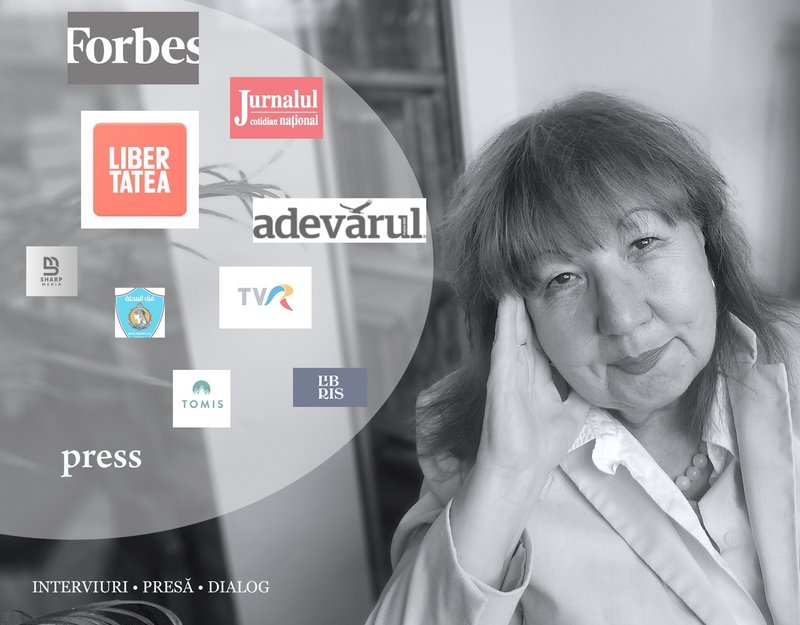
Read together, these interviews form a coherent map of the obsessions and themes that nourish Doina Ruști’s writing.
Selected excerpts from interviews (2019–2025).