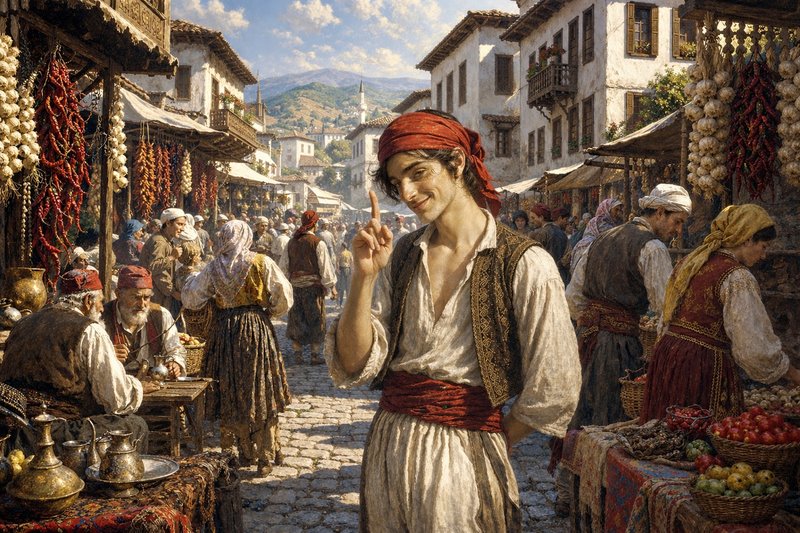
In a dictionary of Balkan imagology, I would place the Spân at the forefront. The word comes from archaic Greek (spanos) and has traveled through most Balkan languages. Albanian preserves it as spärk, related to the Romanian spârc, meaning a boy, beardless. Many words, overlapping meanings, ancient histories from misty times — all have preserved the image of an effeminate and perfidious type. Lacking a beard, he retains the appearance of a child, misleading you, while quietly resting in the shadow of his pious-looking face, ready to hatch mischief and filth.
The Spân appears in numerous folk tales, as a hero of anecdotes and stories alike, always in conflict with the bearded man — typically a priest — whom he deceives again and again.
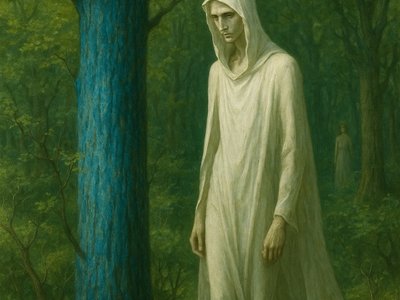
In the Balkan world, full of bearded men, the Spân seems to have fallen from the sky: an improbable presence, a strange woman or an immature man, unisex, standing at the border between worlds. That is why he is depicted as a summer hallucination, a kind of guardian of crossroads, ready to divert travelers from their paths.
Among the tales collected by Hasdeu, there are Spâns who produce arguments endlessly. One cannot even say that the Spân is evil, only that he is extremely convincing. His phrasing is precise. He has charisma.
He often appears as a triad of the roads, especially of the endless plains. When you are exhausted from travel, lost in the open field, frightened by desolation and threatened by Balkan uncertainty, you may encounter three identical figures: three Spâns who have been waiting for you for a long time. They are the apparitions of noon, the illusions of summer — the fata morgana of the Balkan world. Gentle and beguiling, with warm words clinging to their lips, their shaved heads polished by the summer sun.
The three Spâns ask you to do all sorts of things — to search for treasures that endanger you, to multiply your money. They advise you disinterestedly and make you place blind trust in their words.
As a rule, the priest is the Spâns’ favorite victim.
One summer day, a priest sets out for the market to sell his ox and escape his debts. He is sad, worn down by life’s burdens. He meets three Spâns. They praise the animal, speak sweetly. His beard flutters in the July heat; their faces are damp with sweat.
Little by little, they begin to advise him. They convince him it would be best to cut off one of the ox’s horns, assuring him he will get a better price. It would not hurt, they add, to cut its tail and notch one of its ears.
The priest is fascinated, floating. He trusts the Spâns, though they are strangers, and does exactly as they suggest. He surrenders to illusions that always promise a future made of sweets and delights.
And of course, at some point, when it is too late, he realizes he has been deceived. What a feeble word that is! Notice: it is never said that he was foolish, only that he was deceived. Misled. Lied to. Manipulated. Deluded. All of this implies a touch of sorcery, an otherworldly power of seduction — the ability to string someone along with sweet promises, as we say.
Yet we cannot call the Spâns swindlers, for they gain nothing from the priest’s loss. So why deceive him? For amusement? Ordinary tricks belong to laughter, to harmless games. But the Spâns’ tricks are sinister — they belong to malice, to destructive laughter. They are evil spirits, akin to goblins and forest witches, minor deities with limited powers.
They are not main characters, but catalysts of the evil within any man, for the priest, enraged, takes revenge. From here on, the tale turns oriental in flavor: the priest, once naïve, becomes as cruel as the three Spâns, punishing them in countless ways.
In turn, he convinces them to buy from him a donkey full of gold, a pot that cooks by itself, a trained rabbit that runs errands. Once home, the Spâns realize they have been tricked. Who has ever seen a rabbit do the shopping? Or a donkey full of money? Their naivety is almost shocking, given their reputation.
Angered, the Spâns decide to kill the priest. They tie him up, place him in a sack, intending to throw him into the waters of the Mostiștea, where it widens into a marsh filled with spirits.
Lacking a large enough stone, they go off to find one, all three together, as often happens in tales.
Meanwhile, a shepherd appears. Hearing the groans from the sack, he asks what has happened. The priest, skilled in invention, tells him he is to be converted — forced to marry a sultan’s daughter and live a life of luxury. But he refuses such a fate! Everyone knows it would be disastrous for a Christian priest like him.
By now he is more convincing than the Spâns, more cynical. A survivor, shaped by their lessons. The shepherd is deceived and dies in his place.
After throwing the sack into the water, the Spâns are in for a surprise. The game resumes, endless and contagious. The priest deceives them again: he tells them that at the bottom of the river he found a magical realm, where he received a flock of sheep and a new life.
Amazed, the Spâns wish to see this kingdom of happiness. With their bald heads shining in the late August sun, they leap into the water and drown — in the most foolish way.
In a sense, the story is a sad one: the priest loses his innocence, the Spâns die, the shepherd is killed.
What remains is the absurd world of the three Spâns, rulers of the roads — languid, freshly shaven, with coaxing speech and, above all, incapable of understanding others’ jokes. They are the gods of the plain, prototypes of the Balkan world. Malicious? I wouldn’t say. Rather, fed on hot peppers.