Across from Cișmigiu there is an unremarkable little street called Silfidelor Street. Not because winged fairies or dancing gnats might fly through the air there, but because Saint Elijah–Gorgani Church stands nearby. In the time of Șerban Cantacuzino, the church likely had a cemetery, which inspired a civil servant with a vivid imagination to register this name in the records.
The street, the hillock, and the church are remnants of a once extensive neighborhood called Gorgani, which began here and stretched between the riverbed and the large marsh owned by the merchant Dura. It was a swampy area, interrupted by pools of water and reinforced by seven stony mounds called gorgane. Some believed these were ancient burial sites. Others attributed magical functions to them. It was even said that the largest mound—older than Bucharest itself—was a necropolis of ancient monsters, and that alongside their giant bones lay heaps of gold, as well as a great stone book in which those ancestors had carved the mysteries of life. On the summit of the largest mound a church was built, dedicated to Elijah, the persecutor of all demons. Even so, the name endured, and the church became Saint Elijah–Gorgani.
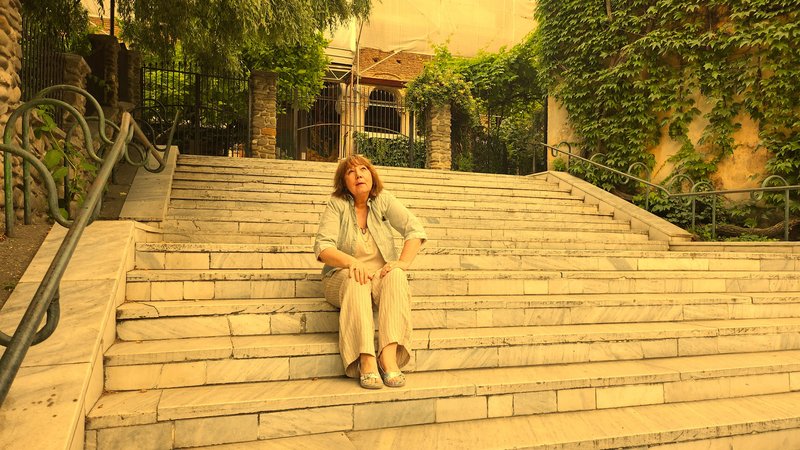
Because it stands on a height, there are steps leading up to it—and it is these steps I want to reach.
Once upon a time there lived a luxury dressmaker who is said to have flourished at the beginning of the twentieth century, becoming something of a Bucharest celebrity immediately after the war. Her name was Lisette, and elegant women never said I had a lace dress made, but simply a Lisette dress.
And the garments she made truly were unlike anything else. She was an artist who created unprecedented pieces; no two dresses were ever the same. She worked with silks, crafted skirts and blouses, chiffon ruffles, and above all stiffened collars that gave a dress the nobility it required. She made jackets with three-quarter sleeves, lace vests, but especially evening gowns.
Her career reached its peak after she created a golden satin dress with a low waist and layered skirts, made of Romanian silk known as borangic. The dress, sewn for a banker’s daughter, fluttered before refined guests at the grand ball of the Romanian Bank, the young woman completing it with a fox-fur shawl. You looked at the dress and suddenly felt a mad desire to spread your wings and fly—only to realize, in the end, that without a Lisette dress, life no longer made sense.
The banker’s daughter, who until then had been unremarkable, shone in that dress the way people touched by angels—or by sylphs—shine.
And whenever such a being appears, imitators and boundless energies soon follow.
Dozens of women fought to commission a similar dress. A line formed at the dressmaker’s gate, and some enterprising souls were already drawing up lists, seeking ways to gain entry into Lisette’s house.
But Lisette had a rule. As soon as she received a request, she went to Gorgani and sat on the church steps at noon, when the little wing descends from the sky—what some call inspiration, others grace, and most revelation.
It was her moment of meeting the guardian of the world—or perhaps not him, but at least a counselor, a friend, a voice that helped her make a decision. It never lasted long: a minute or two, perhaps five at most, and she would leave smiling. As soon as she returned home, she knew for certain who deserved—or did not deserve—a dress “signed” by her.
She gave no explanations. She never stated the reason for refusal or acceptance. She said yes or no, without anyone knowing why. For some, the lack of explanation is what hurts most—absurdly so, I would say. A no is an option; you receive it and move on. Let’s be honest: whom have you ever met who truly needs the explanation of a refusal? The rejected person wants validation, wants to be told they are brilliant, and so on.
Thus dramas followed. Rejected women fell into depression or committed suicide. Others became dress thieves—or even murderers. The newspapers of the time are full of melodramas whose cause was our luxury dressmaker.
Despite the fact that it all stemmed from the steps at Gorgani, no one went there to repeat the dressmaker’s experience, to reach the root of refusal in one way or another. I do not know why. What I do know is that on these steps, at a certain hour at noon, a wing still descends—even today. And to keep it short, I would say you should try it.
On the staircase—which we might rightly call the Stair of Gorgani—sad, indecisive, unlucky or desperate people; abandoned souls; those sick with vanity or envy; the rejected, the powerless, those at a crossroads; or, on the contrary, the puffed-up without cause, hollow ones, pack remnants—all have a chance to meet not a demon or a saint, but the dreams of the luxury dressmaker who sewed fairy-tale dresses and left behind a state of mind. And if they are lucky, they will reenact an experience situated on the thrilling line between today and tomorrow.
It is said that sometimes the name Lisette can be heard, whispered by a mysterious voice, and whoever hears it is granted, if only briefly, the exaltation that seizes great artists.
As for the dressmaker herself—what can I say? She met the fate of all people touched by talent. Somewhere, in a small newspaper item from the 1930s, I found a note stating that the famous Lisette was killed by one of the women for whom she could not sew a dress. And I wonder what would have happened had that woman—rejected, humiliated, left without the coveted garment, and ultimately Lisette’s killer—received a dress after all. I believe it would have been the same. Beings who do not deserve a dress, if they receive one nonetheless, will never be satisfied. Such a being does not truly want the dress; she wants the place she believes is occupied by someone else. Therefore, I believe she would have killed anyway.
And to conclude: Silfidelor Street, number 5, stands for me at the top of Bucharest’s miraculous geography—as one of the city’s midday altars.