The year 1923 was thrilling.
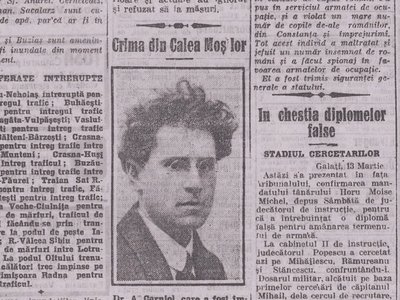
From time to time, newspapers even attempted an inventory of the serious events, giving the impression that Bucharest had turned into a kind of city of horrors. One journalist listed several of them: the disappearance of a billionaire, the murder of Coller in the city center, the enigmatic death of a doctor from Calea Moșilor (about whom I have just written in a recent novel)—these are only a few of the violent episodes of a memorable year. And among them stands the story of a corpse found behind the Decebal Mill, in Rahova.
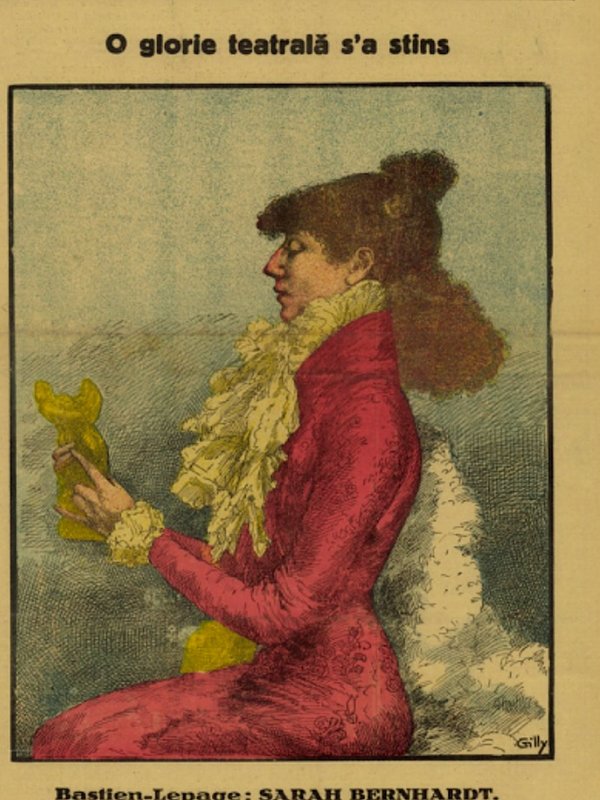
It is the morning of March 27 of that year, and some of Bucharest’s inhabitants are still wiping away the tears shed for Sarah Bernhardt, who had died the day before. It is cold and grey, and from a puddle on Câmpul Sebastian a boot emerges, its lace neatly tied.
The police are called, journalists arrive to take notes. Grim faces; a red hand numbed by the cold writes down what the sergeant dictates. The corpse belongs to a girl, of uncertain age, not older than twenty. Although she is dressed for the house, in a red dressing gown, she is wearing street boots. Possibly she had come from somewhere and had not yet had time to take them off. Perhaps the murderer put them on her, intending to change the place of the crime. I nevertheless rule out this possibility, because the girl is also wearing stockings—black, matching the boots—which are harder to put on a corpse. In fact, the description is quite detailed. The dressing gown buttons in the front, coquettish. Over it, the girl wears a “trico,” that is, a thin knitted sweater made of wool, brown tending toward beige, with green stripes. Most likely she knitted it herself, keeping the green yarn in her pocket to use from time to time for the stripes—horizontal, of course, because they are easier to make. Under the dressing gown she wears a “shirt,” a fine dessous made of white zephyr fabric with black polka dots. The description does not end here. On her wrist the girl wears a red string, from which hang several silver and nickel coins. It is still the month of the mărțișor.

We can already see her: it is Friday evening. The girl finishes her work. She is in her dressing gown and expects someone to come to visit. The hours pass, but no one comes. There is a man with whom she has a relationship not very old, one built on violence and passions inherited from social conditioning: the girl is missing three teeth from her upper jaw. She is not very tall, has chestnut hair, recently cut, and has just turned twenty. She does not live in Rahova. In all likelihood, the crime took place in another neighborhood. Still, not too far away, because I cannot imagine the murderer carrying a corpse all the way from Băneasa. What is certain is that no one among the locals knows her. Near Decebal Mill, the journalist says, several hundred people pass by in a steady stream. But no one saw the dead girl. She is alone, she ran away from home long ago. She knows very few people. Perhaps she has a face that is immediately forgotten. She has recently changed her appearance and her habits. We will never know. She is only an anonymous figure from hidden Bucharest. Yet she has somewhere a dwelling, a wardrobe from which she took the striped sweater after the hours passed and Friday evening slipped further on. She could no longer bear the waiting and put on her stockings and boots, slung a sweater (with stripes) over her back, and crossed the street. She knocked on a door at which she had surely knocked on other evenings as well.
The man opens the door. The argument is heated.
After the autopsy we learn that the girl died of suffocation. The murderer tried to silence her, to erase her from the landscape of that night, in which Friday melted into Saturday. Perhaps it was an accident. Perhaps it was a premeditated death. The man carried her to Rahova by car, a second-hand automobile, and threw her into a puddle behind the mill. This is where the life of a girl who had put on black stockings on a Friday night came to an end.
What is not known is that during that week, one night earlier, the entire city was seized by strange dreams. Many people dreamed of Sarah Bernhardt. It was her journey before dying. Actresses from the National Theatre dreamed of her. Ionel Brătianu’s driver (he was prime minister at the time) dreamed of her; she also appeared in the dream of a schoolteacher from the Napoleon Bonaparte neighborhood. Finally, as you already know, Zavaidoc dreamed of her too. She also appeared in the dream of a student, the son of a lawyer from Buzău, who at the time was renting a room on Coriolan Street. Sarah’s voice—known for its power to take you exactly where it wished—entered his brain and he could no longer drive it out. It nested there, made room for itself, in all the important drawers.
A day later Sarah Bernhardt passed into the other world, but her voice remained there, like a command. The student took the pillow embroidered by his mother and pressed it over the mouth of an impetuous girl. And afterwards, night after night, the dream repeated itself, twenty years without interruption.
In 1943, again at night, the former student—the secret murderer, the former bearer of the pillow—was advancing across an endless field on the Eastern Front. Sarah Bernhardt appeared before him, shattering him. It was she, exactly as in the dream, and looking into her eyes, he heard not the old voice, but the whistling of a bullet that had been looking for him for a long time.