A few days ago, I met Carmen Corbu in one of Bucharest’s gardens. She had a small pencil case from which she drew a fountain pen—the sophisticated kind that uses inks reminiscent of ancient chancelleries. Without even looking at me, she wrote directly on the tablecloth—oh yes, starched damask—“What does the world around her look like to Doina Ruști?” I could hardly believe she was asking me, especially since there were other people at our table. And as the lake shimmered in the distance and the last little hornbeam leaves showed off their finery, I too took out my pen—a cheap ballpoint bought at Carrefour—and wrote down whatever came into my head at that moment:
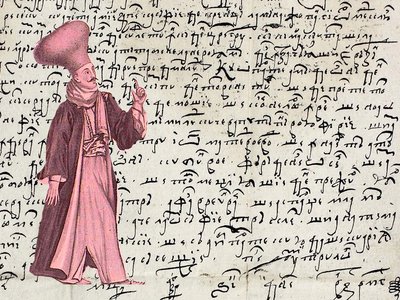
Whenever I return to the Phanariots and the world of the past, I do so because the aftershocks of certain events reach all the way into my insignificant daily life—events so powerful that I realise they changed everything around them, and that their reverberations nourished emotions which entered and decisively shaped our collective imagination. Recently, I read a few lines in an old folklore questionnaire. Someone—a schoolteacher from a village in Dâmbovița—had written to Hasdeu with a summary of a story he had heard. It was about three beardless men...
Of all the questions she asked me, this was the one I liked best:
If the world, like art, is in the eye of the beholder, what does the world around her look like to Doina Ruști? How many cities are there within the city of Bucharest? And how many Romanias are there within Romania?
Every writer’s world is infinite, but naturally, its labyrinth contains landmarks, discoveries and, of course... the mischievous Minotaur. I have always been drawn to a powerful narrative, one capable of creating an entire universe. I am interested in the story that transforms the event. What I mean is that literature begins beyond the mere recounting of facts, however astonishing those facts may be.
Whenever I return to the Phanariots and the world of the past, I do so because the aftershocks of certain events reach all the way into my insignificant daily life—events so powerful that I realise they changed everything around them, and that their reverberations nourished emotions which entered and decisively shaped our collective imagination.
Recently, I read a few lines in an old folklore questionnaire. Someone—a schoolteacher from a village in Dâmbovița—had written to Hasdeu with a summary of a story he had heard. It was about three beardless men who trick someone. Yet beyond the diegesis, the shadow of the three men rose languidly—hybrid creatures, slight and treacherous, at times dissolving into the summer heat.
And it is here, amid the vapours of a possible event, that the true story begins for me: I hear the turn of the carriage wheel and see the road climbing towards Bucharest—towards Bucharest in any of its ages. What matters is not the event itself, but the shadow cast by those three figures, absurd presences scattered along every person’s path.
Beyond those beardless men begins the real world—a world in which, for instance, the words lost along the streets of Bucharest are more powerful than deeds. The Colțea district, the invisible Lipscani Square, Gorgan Hill, Brâncoveanu’s Mulberry Tree or the Russian Church no longer belong to any concrete geography; they are landmarks in a subjective world, and consequently time no longer matters.
I often walk near University Square and, without meaning to, catch the scent of indrușaim from a garden that once stood roughly where the statue of Michael the Brave now stands—a garden created by a teacher at Saint Sava as an educational experiment. I believe that no one can pass that spot without receiving some sign: a delicate fragrance from the flowers of another world.
And this belief lies at the very foundation of my literature.
The rest is available in Cultura magazine.