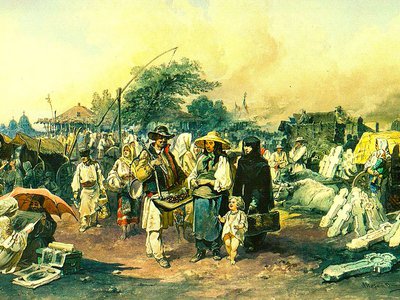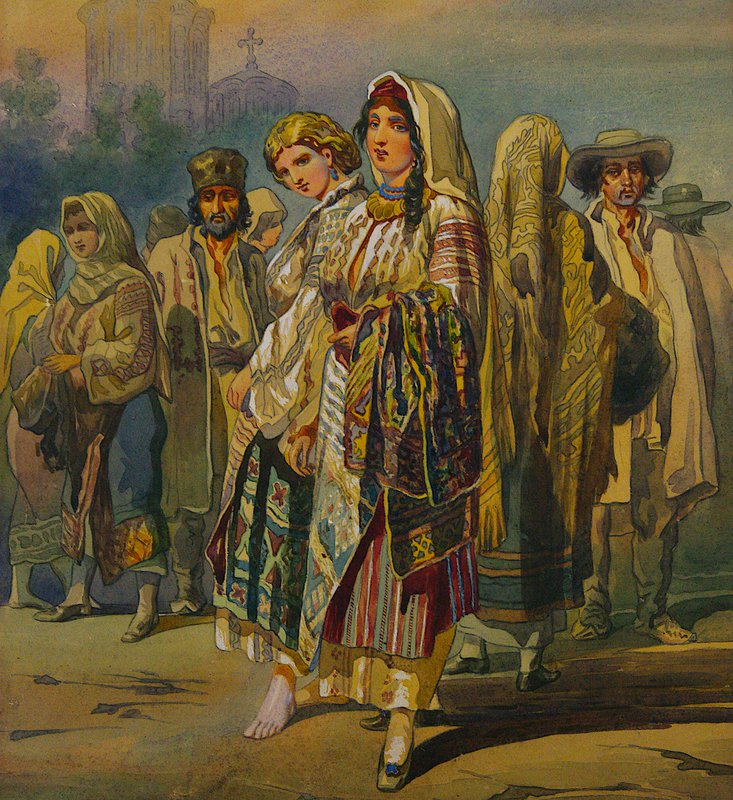
On July 20, Saint Elijah’s Day, traditional fairs for marriageable girls are held throughout Romania, the most famous being the one on Mount Găina. But almost everywhere in the country, such fairs take place on this date—remnants of a vast vegetal celebration that once began with the Paparude rain rituals and ended on Saint Elijah’s Day, usually with a near-ritual rainfall. In our continental climate, it was rare for clouds not to take revenge around July 20.
On the eve of this day, healing plants are gathered—especially basil, kept for Epiphany. That is why July fairs are joyful and filled with flowers, marked by passionate stories, sudden loves, abductions, and sensational marriages.
Late July is also the moment when the fairies, who entered the world on June 24 (Midsummer, the Day of the Sânziene), take flight back to their own realms. And here I must mention a detail that seems to me particularly intriguing. Although invoked in charms and spells, the names of fairies must not be spoken openly. They are occult beings, bound to consecrated spaces—forests and gardens—and it would be a sin to leave them at everyone’s mercy. Only initiates know all their names.
Searching through folklore books, I noticed two things. No respectable sorcerer ever utters the names of all the fairies. Usually, two or three are invoked—sometimes five. Always different ones, always new. Yet alongside them, one figure is invariably present, mentioned at the end of the list: Ilie Cociaș.
Vegetal fairies—the Sânziene, as they are also called—are spirits of healing plants. I will name a few, keeping some, in accordance with tradition, to myself: Iana Sâmziana, Semelchița, Rujalina, Santalina, Avrămeasa, Magdalina, Budiana, Firanda, Bosioaca, Anasia—and, of course, Ilie Cociaș.
At the height of summer, women take part in many rituals, adorned with flowers, invoking the names of the fairies. This happens not only in Romania, but across a wide area, especially in Slavic and Balkan regions. Think of the large floral motifs on traditional Bulgarian costumes. This also explains the presence of Cociaș—a noun of Serbian origin meaning coachman. The word circulated for a long time in Romanian as well, and the form Cociaș has survived as a family name to this day.
Thus, the fairies listed above are accompanied by Ilie the coachman—a detail that leads us both to Christian legends about Saint Elijah and to much older stories, widespread throughout the Balkans or borrowed from Slavic traditions. Fairies, after all, did not travel on foot; they had a driver who ascended to the clouds, just like Saint Elijah. Mixed beliefs, ripened under the sun, giving intensity to human experience.
In a folktale collected by Hasdeu in 1887, from Mehedinți County, it is said that a great fair was held on the banks of the Motru River on Saint Elijah’s Day (when the river had not yet dried up there). Nearby stood a strange rock, riddled with holes and hiding places, known as the Horn of Stone.
Once, as the celebration was in full swing, two men appeared, dressed in German fashion, wearing large, black, newhats. They were charming figures and won everyone’s admiration. But at a certain moment, they seized two girls by force and vanished with them into the fissures of the rock. Since the girls were never found, people concluded that the abductors were zmei—ogres—who lived inside the stone.
This is how legends are born. And this story reminds me of another, more recent one.
In the year 1793, a German arrived in Ploiești. This foreigner—German to the core—was named Petru Hagi Voicu. It was again a fair day; I no longer know whether it was Saint Elijah’s Day, but it was certainly a time when all the fairies roamed the place, accompanied by their coachman.
The German Voicu set eyes on a woman who had come to the fair and, carried away by the atmosphere and the music of the Ploiești fiddlers, simply abducted her, right before her husband’s eyes.
He headed toward Urlați, obtained a travel permit, moved from town to town, and eventually reached Moldavia with the woman—who, it seems, never asked for help. One wonders where she believed she was going.
The case caused an enormous scandal. It was unheard of for a foreigner to abduct a married woman he did not know, whom he had never seen before. The story reached the prince, who ordered the abductor to be captured—which indeed happened.
Because he was a foreigner, the Imperial–Royal Agency was asked to immediately send the culprit back home, to the fortress city of Sibiu, where he could, if necessary, be judged. As I have mentioned elsewhere, whenever a foreigner committed an offense on Wallachian territory, there was only one punishment: to be sent back where he came from.
This time, however, the German was not at fault.
The guilty ones were the fairies mentioned above—and their coachman, Ilie.