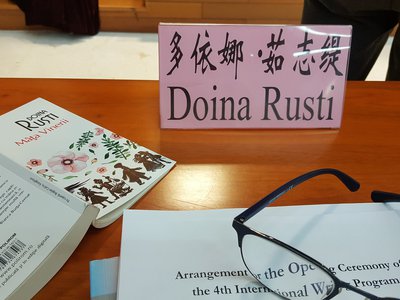
The invitation to the Lu Xun Academy of Literature offered me the rare opportunity to see, from within, a profoundly different cultural world. During my stay, I kept a journal that was published in seven episodes in the newspaper Libertatea.
The texts initially took the form of dispatches from Beijing. The excerpts below reconstruct the course of this experience: encounters with a vast metropolis, with Chinese cultural institutions, with writers and artists, and with the everyday life of the city.
My aim was not to produce a touristic description, but to explore the relationship between a writer and a radically different cultural space, observed from inside a literary residency. These notes are part of a broader project of reflection on contemporary China and on the cultural dialogue between East and West.

My first stop was the police station, to obtain my residence visa: 30 days, temporary resident in Beijing. Five glass-fronted counters, each equipped with a camera. I smile broadly, with a faintly feminine regret that I won’t get to see the photo—after having left my fingerprints at the airport, from three of my most important fingers, without knowing how photogenic they are. I receive the permit, and my literary residency begins, on a splendid March day.
My first real stop is a fruit shop, self-service style, with heaps of exotic produce, including the knobbly jackfruit, whole or sliced, arranged in plastic containers. I take out my newly acquired banknotes, whose value I still don’t quite grasp, while the vendor looks at me suspiciously, carefully examining the paper. I realize I am a collector’s item: I am the only one paying in cash.
On the academy campus I meet the erudite Professor Huang Shao Zheng, who smiles symbolically, as in the Dao De Jing. The garden is full of blossoming trees, and above them swifts are flying, just like in a commercial. I am in Beijing, six hours ahead of you.
Read the full article:
Dispatch from Beijing, Chapter 1 – Doina Ruști in China
Today marked the official opening of the residencies, so a grey coach takes us to the Shaoyaoju district, a kind of local Băneasa. Relaxed atmosphere, monumental building, inside which we hurry through a literature museum. My attention is drawn to niches with characters—elegant figurines illuminated by LEDs. Their union is led by writers of the 1980s generation, and the supreme leader is a woman, the novelist Tie Ning. Naturally, isn’t it? By noon everything ends gloriously, including lunch and the festive part. I refrain from photographing the food, saving this pleasure of circulation for the following evening, when I will dine with a friend.
Read the full article:
Dispatch from Beijing, Chapter 2

This evening I dine with Li Xinduo, a calligraphy professor at the Beijing Academy of Arts. In China, as is well known, writing is more than anywhere else an art, and Li transforms life’s events into pictograms or their ghosts, wrapped in smoke. I first met him in Bucharest through a mutual friend, and now I meet him again at home. We go to Middle 8, a Chinese restaurant in an elegant mall. Pleasant atmosphere, nice people, charming booths, and an abundance of cream-colored organza.
On the tables, instead of printed menus—IT tablets. He reads the ingredients carefully; I stare at the pictures, as if online. I finally choose mo gu san bei ji—mushrooms with two spicy sauces, garlic, and shredded chicken—very tasty and, in my opinion, more than sufficient for dinner. But more follows: caramelized eggplant, fried pork with sweet sauces, and of course rice, which I initially refuse even to taste. Eventually, yielding hypocritically, I take a bite and become attached to it for the rest of my life. Slightly spicy rice, with peppers, meat, roasted chestnuts, and fragrant, cryptic spices that bring all my weaknesses to the surface.
Read the full article:
Dispatch from Beijing, Chapter 3
I leave the academy intending to reach the Forbidden City. I take a taxi and first get off at the Museum of Contemporary Art. The cold is sinister, and a sharp wind tears at my hood—metaphorically. The city is majestic; it’s clear I’ve reached the center: tall buildings, wide boulevards, and clusters of people, each group marked by caps of the same color. Where they are going and what they are doing—I cannot tell. Many wear sanitary masks, some decorated with drawings.
I enter the Museum of Contemporary Art, where admission is free—the first museum in the world where I don’t pay. Security, however, is strict, like at the airport. A vast space, with works dedicated to the year 1997, themed around the recovery of the South. Paintings about the joy of people from the north and south of China, mostly idyllic realism, but also abstract pieces. I am especially drawn to a canvas depicting a landscape: intensely green trees by the sea, and many white birds in the foliage.
Read the full article:
Dispatch from Beijing, Chapter 4
I hear that in Beijing the best transport for those without cars is the subway—very safe, with clear directions. From the academy to Tiananmen Square it takes nearly an hour, with three changes. The downside is that there is no Wi-Fi underground, but there are alternative methods. A Romanian student writes her number and a message in Chinese on my phone, assuring me that if I show it to a Chinese person, they will certainly offer their phone so I can call. Worth trying—though perhaps activating roaming is better.
Today I only test the terrain. I go up and down several times, countless stairs. I’m not yet ready for a long journey. But I notice that people waiting on platforms obsessively tap on their phones. Eventually I return to the academy for a scheduled meeting with Gao Xing.
Read the full article:
Dispatch from Beijing, Chapter 5

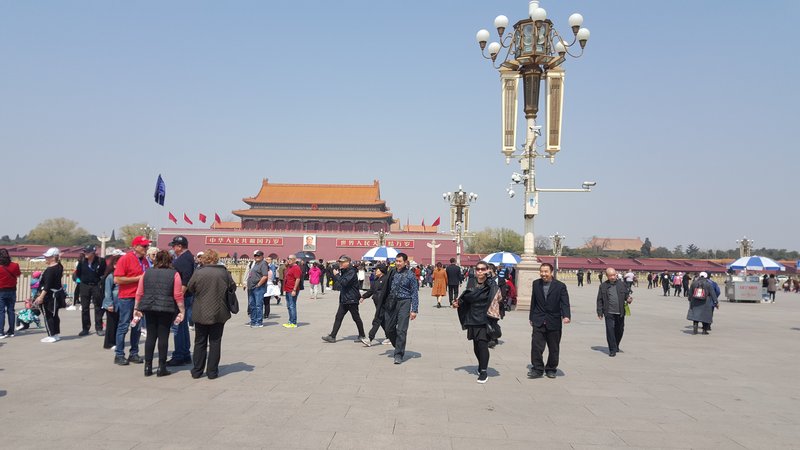
There are two symbolic locations that give you a sense of China’s history: the vast, grey expanse of the great revolutionary square, and the old city of emperors—the well-known gate from postcards, with Mao Zedong’s portrait as a huge seal over the dynasty he overthrew. To reach this gate, I must cross the square and pass a boulevard as wide as the Danube, naturally via an underground passage.
At both entrance and exit there are police checkpoints, strict filters, and detectors of all evils. I show my passport, place my bag on the conveyor belt, and allow myself to be patted down by a smiling Chinese woman. I exit the passage and enter a metallic labyrinth for yet another control. The road to the Forbidden City is long and full of trials. At the entrance, next to Mao’s portrait, a line of vigilant guards directs us toward the gate.
Read the full article:
Dispatch from Beijing, Chapter 6
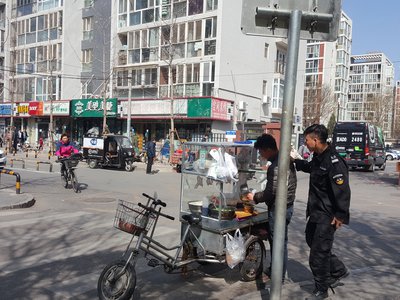
Beijing strikes me as immense, yet in a certain sense familiar, largely because of its contrasts. I pass a mall in front of which hundreds of bicycles are parked; nearby, rows of clothing hangers line the sidewalk. The central boulevard is packed with expensive cars, mostly Audis. As at home, among socialist apartment blocks rise majestic buildings of foil and glass, bearing the names of multinationals and European banks.
In one such building is the Hai di Lao restaurant (hot pot). Here, Chinese food is served—delicious, and necessarily freshly cooked. Upon arrival, we receive warm towels and lemon water. My glasses are quickly placed in a self-sealing pouch, while covers protect the coats on the chair backs. A caring hand offers me a hair tie.
At the Great Wall there is a sea of people, scattered across the commercial area, with restaurants, hotels, and—inevitably—stalls, as in any tourist destination. Jade figurines are sold here, bronze statuettes, ornaments, printed T-shirts, little flags, caps with the red star, and even paintings reproduced from photographs, among them a portrait of Xi Jinping, purring like a tomcat. For those in the mood for a stroll, there are also small red buggies, fluttering with the republic’s flags.
The road to the Great Wall is still long. We take a bus that drops us at the foot of the mountain, where I must choose between a classic cable car and a small vehicle I could drive myself. I opt for comfort and step into the cabin together with Nori, a Japanese writer who, like me, has a fondness for convenience. The others, braver, take the little cars.
Read the full article:
Dispatch from Sichuan and Beijing, Final Chapter \| Doina Ruști on walking along the street of one of China’s greatest poets and a trip to the Great Wall

Chengdu is the capital of Sichuan Province and the place where the poet Du Fu spent the last years of his life—a poet I learned about in school, without ever imagining that one day I would stroll along his street. It is a large city, like a European capital, with many quirky buildings, lights, and nightlife. Fruit carts roam the streets, inevitably laden with tamarillo, mangosteen, and large, very fresh oranges. There is abundant greenery, and among the ficus trees and exotic foliage I glimpse, not without emotion, ripening cherry trees.
Du Fu’s neighborhood is, in fact, the old town, made up of two main streets, Kuan and Zhai, full of shops, restaurants, and street performers dressed in spectacular costumes. And crowds swirling through intoxicating aromas—roasts and cinnamon. Sauces, frying oil, cinnamon, and the unmistakable red Sichuan pepper, prepared in a sweet-and-sour sauce, never missing from any plate.
Read the full article:
Dispatch from Sichuan and Beijing, Final Chapter
In the evening I go out for a walk together with a Bulgarian novelist. The city feels safe, and people are kind. From time to time we encounter someone dressed in priestly garments—Buddhist, of course. I see one of them getting into an elegant car, which reminds me of cathedrals, lineage, and ecclesiastical commerce. I don’t let it disturb my zen, though, and listen instead to Zdravka telling me about the novel she is writing.

Yet the theme of priesthood everywhere follows me mystically: dressed in Buddha’s robe, a young, devout man takes his evening walk along the banks of the Jǐn Jiāng River, and a few steps behind him walks a servant—humble, ageless, and, I would dare say, without plans. I don’t say it, because a Chekhovian sprite reminds me of the complex life of the humble human being.
Read the full article:
Dispatch from Sichuan and Beijing, Final Chapter
Read Doina Ruști’s complete China journal
Read the full article:
Dispatch from Beijing, Chapter 7