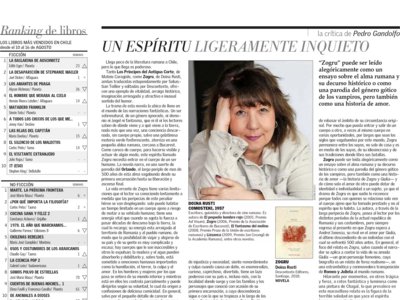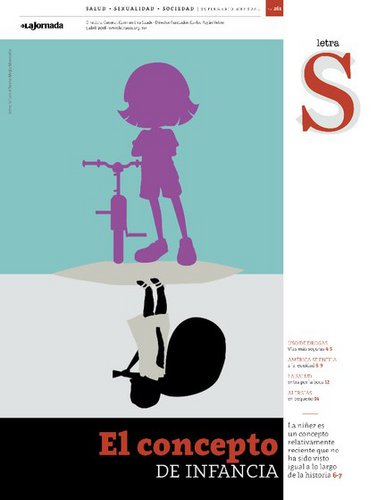
Recently, a review dedicated to the novel Lizoanca appeared in the Mexican daily La Jornada, in its cultural supplement Letra S. The text is signed by Dulce Carpio, who highlights the distinctive character of Doina Ruști’s prose within the context of contemporary literature.
La Jornada is one of the most influential newspapers in Mexico and in the wider Latin American cultural sphere, and its cultural supplement pays special attention to international literature. In this context, the novel Lizoanca is presented as a work of great narrative force, capable of transforming a difficult subject into a complex and memorable literary construction.
In the review published in Letra S, Dulce Carpio notes that the novel stands out through a singular narrative style in which the present and the past of the characters overlap, while individual experiences intertwine with collective memory. In this reading, Lizoanca becomes not only the story of a destiny, but also a radiography of a society marked by the traumas of recent history.
The author of the review emphasizes the way the novel integrates reminiscences of communism into a well-articulated fiction that goes beyond simple social reconstruction and turns into a profound literary reflection on marginalization, abuse of power, and human vulnerability. Lizoanca is thus read both as a story of fate and as an exploration of the social mechanisms that can generate violence and exclusion.
The novel follows the fate of a girl from a Romanian village, an apparently quiet community crossed by tensions, prejudices, and collective fears. At the center of the story is a child placed in an extreme situation, around whom the adult world gradually reveals itself, with all its hypocrisies, anxieties, and complicities. From this perspective, Lizoancabecomes a story about innocence and guilt, responsibility, and the way communities react when faced with situations that challenge their own values.
The review in La Jornada highlights the power of narrative detail and the author’s ability to create memorable characters situated at the intersection of harsh reality and literary imagination. The analysis also emphasizes the expressive density of the text, as well as the balance between realistic documentation and fictional dimension, which gives the novel a constant narrative tension.
In the interpretation proposed by the Mexican publication, Lizoanca appears as a literary work rooted in a specific place, yet one that transcends its local context and acquires universal relevance. This ability to transform a particular experience into a story with broader resonance is one of the defining traits of Doina Ruști’s prose.
The appearance of this review in the Mexican cultural press confirms the international interest in Doina Ruști’s work and the continued circulation of her novels in diverse cultural spaces beyond the borders of Romanian literature.
The full text of the review can be consulted in the Letra S supplement of the newspaper La Jornada.
Independent and surly, suddenly turned into the main public enemy, Lizoanca shakes an entire society and brings to light the unsuspected secrets of a rural settlement called Satul Nou. Some want to turn her into a star, others into a victim, and others into the guilty one. Over the course of a summer, Lizoanca becomes the central character of the country, but especially of the small community in which she lives. The age of eleven turns into a true narrative matrix: each adult in Satul Nou has a story connected to this age, and these stories gradually compose a collective portrait of the victim.
Read also the preface to the critical edition in the author series.