Gianluca Veneziano on Lizoanca at Eleven
(Il Libero, Turin International Book Fair, 2012)
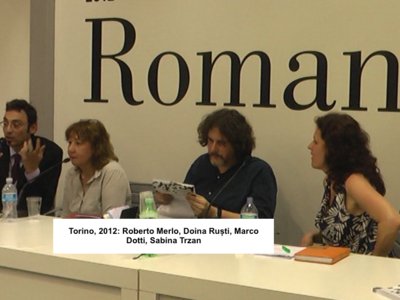
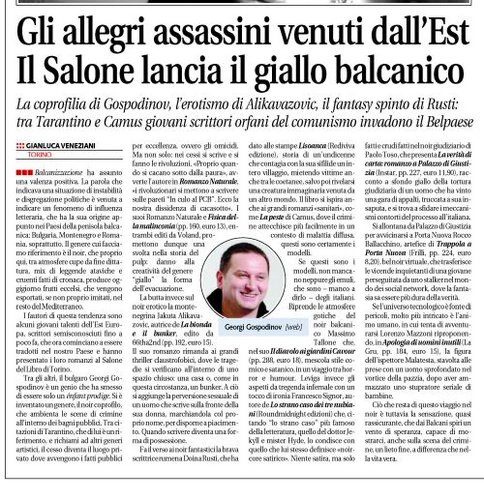
At the Turin International Book Fair, the Italian press took note of a new generation of Eastern European prose writers, among them Georgi Gospodinov and Doina Ruști. In an extensive article published in the daily newspaper Il Libero, journalist and critic Gianluca Veneziano describes Lizoanca at Eleven as a novel with a strong moral and symbolic impact, comparable to Albert Camus’s The Plague.
The article situates the novel within a broader context of post-communist Eastern European literature, alongside authors such as Gospodinov and Alikavazovic, marked by a harsh yet deeply ethical realism. According to Veneziano, these novels do not rely on sensationalism, but on literature’s ability to expose the mechanisms of social violence, moral decay, and collective guilt.
The comparison with The Plague highlights the allegorical dimension of Lizoanca at Eleven: a community confronted with an evil that does not come from outside, but is generated from within. In this reading, the novel becomes not only a realist narrative, but a meditation on responsibility and human fragility.
This early international reception confirms the novel’s impact and positions Doina Ruști within the European conversation on memory, trauma, and post-totalitarian literature.