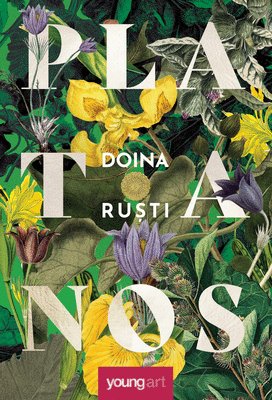
The page includes the novel’s critical reception: excerpts from reviews, articles, and mentions of Platanos, together with references to their sources. Among those who have written about the novel are Mihai Ene, Luiza Negură, Emma Neamțu, and others.
Critical Reception
Platanos is an allegory of plants-as-adolescents; its theme is friendship—true friendship—and its central idea is: “in the shade of great trees, nothing grows but weeds.”
more
Lecturiada
With pronounced dystopian infusions, Platanos (ART Publishing Group, Bucharest, 2025) is a novel of carefully studied versatility, bringing together all the major lines of force characteristic of Doina Ruști’s writing: a form of magical realism, hyper-lucid observation, grave meditation, acute perception of the world, the demiurgic power of the word, the subtle complicity between narrator and discourse (and characters), as well as a singular sliding between textual frames, among others.
Exacerbated, the sense of sight expands its field of use, acquiring a metatextual function. As in the author’s other novels, it weaves into its symbolic inflections all the stages of constructing a mise-en-scène, finding its full articulation in the dynamics of the character’s inner world.
Brave New World (Aldous Huxley) becomes a metaphor of conquest, of the subjugation of the human through alterity—here, a vegetal one!—a transposition imposed as a consequence of evolution. The new garden of vegetal beings turns into a genuine agora, an unprecedented extension of the stage. Not by chance, the intervention of the chorus is quickly perceived by Sisinel, though he is himself captivated by a declamatory sequence. The search for the road home provides the occasion for a disturbing reflection, an essential aside in the economy of the novel: “I went down the street with the feeling that I was on my own. Alone in the world, like in the novel Platanos had recommended to me.” (p. 122) What had initially defied the social norm had now become normality, the entire world playing a similar role.
A story about the intrinsic relationship between appearance and essence, Platanos reconstructs, on the deeper plane of meaning, a Don Quixote–like quest. The striped notebook is only an artifact; yet it is precisely the steadfast belief in the healing possibilities it offers that governs the plane of action. The tableau-like narration marks a return toward a form of non-forgetting, a consciousness that seeks the resources of survival in the fabulous experience of encountering the all-powerful djinn—a constant (and unexpectedly real!) presence in Doina Ruști’s writing. more
Luiza Negură, Convorbiri literare, November 2025
Beyond its ending, Doina Ruști’s story is articulated with extraordinary precision in its depiction of the psychological mechanisms that come into play within a radically altered reality: the rapid shift from generosity to self-interest, from ideal to totalitarianism, from truth to propaganda. Above all, there is a sincere friendship, fractured by the changes produced by this new context. Hundreds, perhaps thousands of such cases are known from all moments in which societies have passed through crises and profound metamorphoses, especially when these have led to various forms of totalitarianism—fascism, Nazism, communism. In all such instances, the attack on education is fundamental: whether books are burned or banned, school becomes fertile ground for propaganda (after public schooling is shut down, a private school soon appears in the vegetal world, opened by Willow, a protagonist who has become an ardent supporter of the new order). The egalitarian illusion also collapses in the new world, for it proves that even within the vegetal kingdom there are plants considered superior and others deemed inferior: imposing trees, but also weeds, shrubs, mosses and lichens, even poisonous plants. Hierarchies, discrimination, and the minority category of the “odd,” the “different,” still exist—only along other coordinates and according to other reference points.
Built on several textual levels, Doina Ruști’s story has the merit of simply describing complex social mechanisms and of warning against the utopian illusions that can often animate human society—the danger being precisely dehumanization, the loss of human reference points, and the triggering of collective traumas that cannot be erased even when society “heals” and seems to regain its lost or severely damaged humanity. A novel for children of all ages, who will thus better understand that the source of evil may arise from unrealistic hopes themselves, when a utopian dream is rapidly transformed into a grotesque nightmare.
more
Mihai Ene, Scrisul românesc, December 2025


