Here is the English translation of the provided Romanian text:
Pagan Antiquity is preserved in the intimate structures of Christianity. In the world of the 3rd century, the acceptance of the Christian God is preceded by many searches, by the finding of a path through which to maintain the connection with Antiquity. Among the cults of this period, the Mysteries of Mithra enjoy the greatest popularity in the Roman world, representing an intermediate variant between the religion of ancient Rome and Christianity.
The most remarkable intellectual attempt consists in interpreting the Gospels from the perspective of Plato’s ideas. The preoccupation with Greek philosophy — and more precisely with Platonic philosophy — gave rise to an intellectual movement: Neoplatonism — which reflects the desire to reconcile philosophy and religion, reason and revelation.
The first among the Fathers of the Christian Church who was also a philosopher is ORIGEN (185–254). Born in Alexandria into a Christian family, he studied philosophy with Ammonius Saccas and developed diverse intellectual interests. He wrote Gospel commentaries, homilies, but also the Hexapla — a comparative edition of the Bible, placing several Greek translations side by side, accompanied by philological and theological commentaries. His essential work is entitled On First Principles. Here he sets forth his philosophical conception, asserting that in the beginning all spirits were equal and contemplative. Some distanced themselves from the divinity and fell into material condition; that is why man seeks union with God and through this tries to regain his primordial state. The way to restore the initial unity lies in the secret message of the Bible. For this reason he tries to explain the subtle meanings of the Gospels, elucidating the relations between soul and body, between man and God, between Jesus and the divine Word, in Platonic terms. Man was born of love, and Jesus preaches love as a path of return to God. Because man was born in darkness, God becomes the Light of all men. From the Heavenly Father was born an image, a model (an archetype), namely Christ. In turn, men were created in the image of Christ.
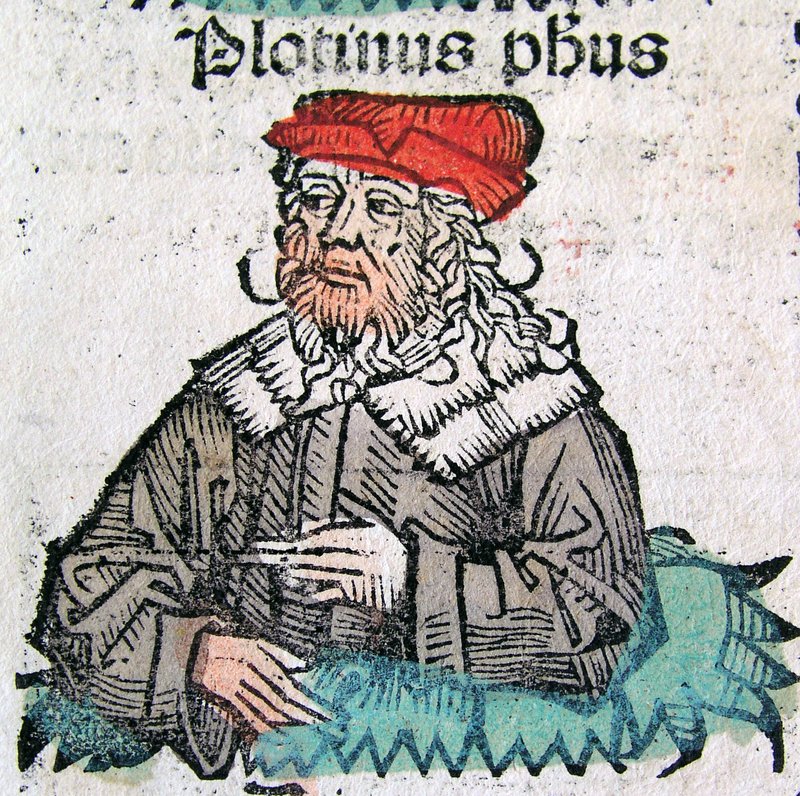
But the founder of Neoplatonism is PLOTINUS (203–270), also a student of Saccas, an Egyptian of Greek culture. His work — the Enneads — comprises six books grouped into nine treatises each, in which he speaks about man, the physical world, the soul, the intellect, and absolute unity. Starting from Plato, and through him from Pythagoras, Plotinus says that the soul must be liberated from the prison of the body, and the way to escape the corporeal tomb is contemplation and detachment from vulgar desires. An impeccable and austere soul can reach the Universal Soul. In chapter II of Book IV, Plotinus addresses the transmigration of souls, linking it to the permanent transformation (sliding) of matter and the world under the dominion of the Universal Soul. He supports his ideas by recounting a personal experience, namely how his soul left his body, floating in a state of harmony and perfection. For him, harmony and love are akin to Light.
Plotinus’s teaching was continued by his disciple PORPHYRY (234–310), of Phoenician origin. He maintains that only philosophers can hope for salvation and attacks the simplistic Christian view of God (in his work Against the Christians). His books were brought to the center of attention by St. Augustine, and among them the Isagoge — an introduction to Aristotle’s Categories — enjoyed wide popularity. Porphyry’s student, the Syrian IAMBLICHUS (c. 250–330), wrote a biography of Pythagoras and turned his interests toward magic, returning to the Hermetism of the Hellenistic age (in his study On the Mysteries of Egypt).
The Neoplatonic movement would continue into the following century through Proclus.
But the indecisive spirit of this century is best represented by MANI (216–277), of Persian origin, founder of the Manichaean religion. He wrote the Kephalaia, in which he expounds a dualistic doctrine created from an amalgam of ideas taken from Gnostics, Buddhists, Christians, and various mythologies. The Manichaean considers himself a fragment of the world. To achieve salvation, man must recover (remember) the secret history of the Cosmos, which is as follows: in the beginning, light and darkness, good and evil, God and matter coexisted, separated by a boundary. In the north reigned the Father of Greatness, and in the south — the Prince of Darkness. The latter wants to conquer the divine Light, and the God of the World creates man and sends him against the Prince. Man is devoured by demons, but the victory of darkness is not complete, for the Prince loses his initial state and is corrupted by the divine spirit; things become mixed, no boundary remains between good and evil. Then Light is almost entirely recovered by deceiving the demons: God tempts them with a very beautiful androgyne; at the sight of it, the male demons spill their seed — which falls to Earth and gives birth to vegetation — while the female demons give birth to humans. These descend to Earth and, by eating the buds of plants, recover the divine light that the demons had shed in their seed. Man, created from darkness, the offspring of evil, becomes spiritualized with the coming of Jesus-Light and meets God, freeing the light imprisoned by demons in the human body; death means the journey of light back to its origins. Mircea Eliade considers this doctrine the most pessimistic vision of human destiny, since man’s appearance is the result of a temporary defeat of God. Manichaeism found many followers and persisted in the following centuries. From it later emerged the Paulicians (7th century) and the Bogomils (10th century).
Representative of the spirit of this age is also ZOSIMOS, considered the founder of alchemy, an occult science whose roots lie in 14th-century BCE Mesopotamia and which penetrated the European area in the Hellenistic period, overlaying popular esoteric practices. In his Treatise on the Art, Zosimos — a Greek who is known to have lived around the end of the 3rd century in Alexandria — speaks for the first time about the separation of matter through an allegory. He dreams that an unknown person (who calls himself Ion) tells of his own mutilation: he was beheaded, flayed, burned, and endured all this to become spirit. Zosimos concludes that Ion is the image of water tortured in fire; in fact, it is about the death and resurrection of matter, the path leading to another existence (through transmutation) — namely an eternal one, therefore called gold, the symbol of immortality. Hence the alchemists’ preoccupation with creating gold (by discovering the Philosopher’s Stone), a symbolic expression of the desire for eternity.
Parallel to these spiritual quests, written culture continues in a traditional manner.
DIOGENES LAERTIUS opens the century with an extremely important work — Lives and Opinions of Eminent Philosophers — which contains extensive presentations of Greek philosophers from the Presocratics to Epicurus. Many works of ancient philosophy would have fallen into oblivion had it not been for this book. Diogenes creates portraits, adds oral anecdotes, transcribes fragments from works lost to us (such as the three letters of Epicurus), and offers pertinent commentaries. His work has immense documentary value.
Also in the first half of the century lived ATHENAEUS, author of an interesting book entitled The Deipnosophists (The Learned Banqueters), in which, under the pretext of recounting a banquet, he gives a faithful image of Greek life, making references to philosophy, expounding ideas, but above all providing everyday details that recreate the spirit of daily life.
HELIODORUS (end of the century), bishop of Tricca in Thessaly, continues the tradition of the Greek novel with the Aethiopica, in which he narrates the adventures of Chariclea, daughter of an Ethiopian queen, abandoned at birth because she was white. In love with Theagenes, Chariclea follows him across the world, but the two are shipwrecked at the mouths of the Nile and then pass through endless perils. The novel consists of numerous interwoven stories.
The interest in animal fables, previously illustrated by Pliny, continues with CLAUDIUS AELIANUS. He left a zoological treatise (On the Characteristics of Animals) and a collection of anecdotes (Varia Historia) on which medieval bestiaries are based.
Also at this time, EUSEBIUS of Caesarea (c. 265–339) inaugurates Byzantine historiography with his Ecclesiastical History (in 10 books).
The general situation of this century is one of crisis and imbalance. The arrival of the Goths in Europe heralds the collapse of the Roman world: they conquer Dacia and gradually penetrate the heart of the Roman Empire.
In China too there is a return to the past, more precisely to the philosophy of Laozi. A School of Mysteries now emerges, with metaphysical preoccupations, whose representatives offer interpretations of the Book of Changes. WANG BI (226–249) is a highly talented exegete who, in an extremely short life, wrote original commentaries on Laozi’s ideas. Other representatives of the School of Mysteries include HE YAN (c. 190–249), author of the Treatise on That Which Is Nameless, and PEI WEI (267–300).
This century is one of confusions and searches; now occurs the dramatic separation from the values of antiquity and the preparation for the triumph of Christianity.