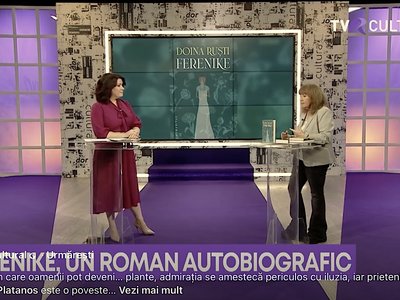
In her intervention, Doina Ruști emphasized that literature cannot function as an ideological instrument without losing its essence. The novel is, first and foremost, a form of creation, and its value cannot be measured by its conformity to a political or doctrinal agenda.
“Being convinced that literature is creation, I entirely exclude the intrusion of ideologies,” the author stated, arguing for the freedom of the imagination and for the writer’s aesthetic responsibility.
The discussion highlighted the risk of reducing the novel to a mere vehicle for ideas. From this perspective, the opposition between the aesthetic and the ideological proves to be artificial: when ideology dominates, the aesthetic dimension is annulled, and literature loses its inherent complexity and ambiguity.
Doina Ruști’s position aligns with a critical tradition that defends the novel as a space of plural meanings, human experience, and memory, rather than as a form of programmatic discourse.
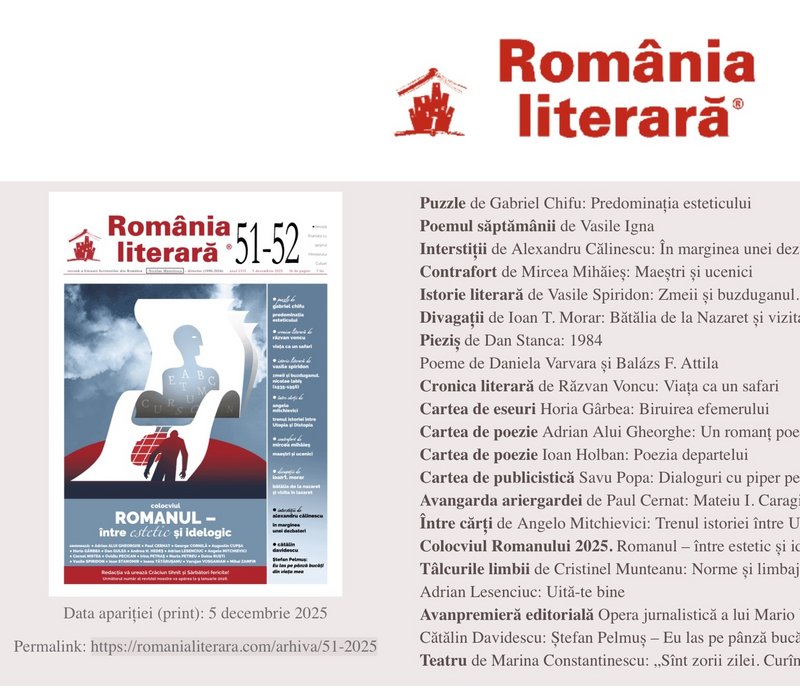
The colloquium brought together writers and literary critics such as Paul Cernat, Angelo Mitchievici, Mihai Zamfir, Augustin Cupșa, alongside other guests from different generations (The Romanian Writers’ Union), who examined the status of the novel in relation to contemporary pressures—political, social, or ideological. The interventions revealed the current tensions within the literary field, as well as the need to reaffirm aesthetic criteria as the foundation for evaluating literature.
Doina Ruști is a novelist and university professor, the author of numerous novels translated into several languages and the recipient of major literary awards. Her work explores the relationships between history, memory, and imagination, combining realism with symbolic and fantastical dimensions.