I
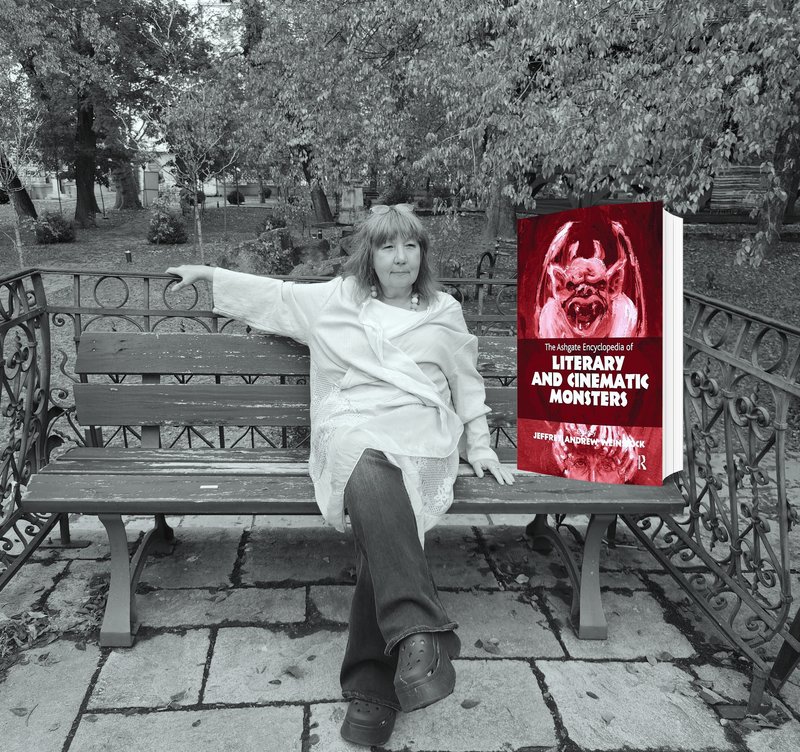
In The Ashgate Encyclopedia of Literary and Cinematic Monsters (Routledge, New York, 2016), edited by Jeffrey Andrew Weinstock, the novel The Ghost in the Mill is analyzed as a form of neo-Gothic, characteristic of late East-European postmodernism. Cited in two places—see page 550 of this major international reference work—the novel is placed within a comparative framework, alongside The Carpenter’s Pencil by Manuel Rivas, highlighting its relevance within a transnational genealogy of narratives featuring symbolic monstrous figures.
In Weinstock’s reading, The Ghost in the Mill stands at the intersection of post-communist memory and the Gothic imagination, revealing a complex narrative architecture marked by baroque accents and an intensified aesthetic effect—defining features of the neo-Gothic mode. Here, monstrosity does not emerge as a supernatural anomaly, but as a structural response to the violence and psychological pressures of communist totalitarianism.
The novel is thus interpreted as a form of East-European neo-Gothic specific to late postmodernism. This classification situates it within an international comparative framework, emphasizing how the Gothic imagination becomes a tool for exploring post-communist memory, trauma, and historical monstrosity.
The ghost is not a singular presence, but a multifaceted one, reflecting the various forms of oppression embedded within everyday normality. There is a single character, generically named Max, whose metamorphoses unfold gradually within ordinary reality. His multiple transformations illustrate how the Gothic is reactivated within a precise historical context, where trauma generates monstrous doubles rather than external terrors.
This critical classification confirms that The Ghost in the Mill belongs to a broader genealogy of modern Gothic, in which East-European literature contributes distinctive forms rooted in history, memory, and narrative complexity.
The Ashgate Encyclopedia of Literary and Cinematic Monsters, edited by Jeffrey Andrew Weinstock and published by Routledge, is a key reference work in cultural and literary studies devoted to the figure of the monster.
Critical reception; Bibliography; Further studies on The Ghost in the Mill