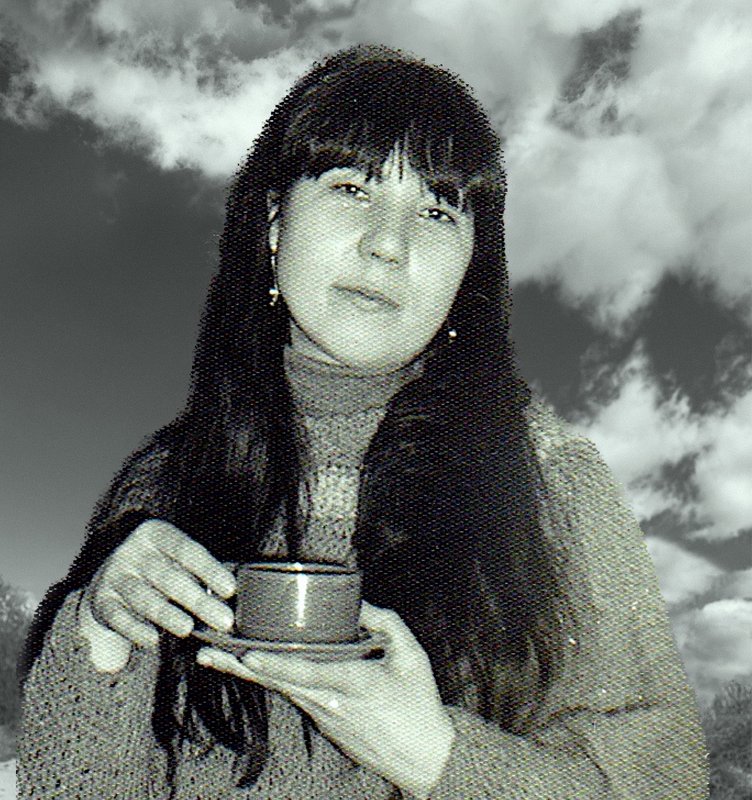
Looking back, I can say—briefly—that things could have been worse. One of the few bright points is my birth date: for a long time it stayed ambiguous, even camouflaged. Officially, my documents place it in March, and early on I even had “martisor” birthdays. Then one day my grandmother told me it didn’t really matter—I could celebrate whenever I wished—but if I truly cared about the exact date, I should know it was February 15.
To convince me, she walked me across the whole house to what we called the room of ghosts, opened her old ledger—the book where she recorded “the important things”—and there I read that I’d been born during apocalyptic rain, when the flood carried away fragile houses and my mother couldn’t possibly leave home. The doctor and the midwife were called, and I came into the world right there, in that sinister room. For the first hour they thought I was dead, suffocated. Ever since, I’ve kept thinking about that first hour—the hour that later became, throughout my life, a private time of reverie and fault. The ledger ended with the precise entry: 15 February 1957, 5 p.m.
Of all life’s stages, my childhood in Comoșteni remains the most important for my intellectual formation. And the happiest part of life is the present moment—when you begin to believe in the force of the present, and in the small battles you fight for changes you may never personally live to see.
Between Comoșteni and “now” there were many events—mostly costly, in energy and in possessions. Nothing came easily. I’m grateful for a stubborn strain I inherited from Aromanian ancestors on my father’s side, and for the obstinacy—Turkish, on my mother’s—arriving as a package deal. With it came a permanent emotional current: history, infatuations, irrational bonds, and other complications I’ve only recently managed to outgrow—thanks to the useful transformation that age performs. What has kept me alive, though, is a love of building: I’ve never been able to leave things unfinished.
My family consisted mostly of teachers, beginning with my paternal great-grandfather (whom I wrote about in The Ghost in the Mill). Books were everywhere—reading lists, family reading sessions, sometimes turning into performances, because my father and his mother—both histrionic souls—recited and read in roles. My grandfather declaimed poems, sometimes accompanying himself on the violin. Those childhood years among thick volumes—The Count of Monte Cristo and others—left a mark. Later, when I became a teacher, I often read aloud to my students, as if returning to the most substantial part of my own life. Everything I truly learned began there, in Comoșteni.
Among the most dramatic events I would first name the deaths of my parents. At any age, it’s unbearable. My father was killed at thirty-five, when I was eleven—an episode I’ve written about repeatedly, especially in novels. My mother, too, should have lived much longer. There were other grim chapters—two years with a Dickensian aunt, and the harassment that comes from imaginary writers—but there were also things worth framing: loves that strengthened my character and my craft, including three marriages. I won’t list literary successes here; I’ll only say that around forty titles have been translated into more than fifteen languages.
If I had to name what mattered most in my formation, it would be independence. At fifteen I was already on my own. High school (1972–1976), at “Garabet Ibrăileanu” in Iași, in the classics track, gave me direction: Latin and Ancient Greek disciplined me; literature kept me alive. But learning to survive alone mattered most of all. Freedom of choice was essential—though it came with a price: eccentricity, contempt for limits. Still, that early freedom refined my instincts. I never truly put myself in danger.
I studied Philology at the “Al. I. Cuza” University of Iași (1976–1980). Later I left Iași and took a teaching post in Tulcea. The end of the 1980s—those brutal years—meant teaching, commuting to Bucharest, and writing without pause: short stories, fantastic fiction, anything. I wrote an early version of The Ghost in the Mill before 1989, determined to publish it—only to discover that entering a publishing house in communism felt like trying to enter a guarded military objective.
After I moved to Bucharest, the Revolution erupted—the defining event of my life. On 21 December 1989 I was in the streets, freshly resigned, ready for war.
After 1989 I worked at Humanitas, then taught in Bucharest, while also teaching at the Faculty of Letters. In 2000 I earned my PhD and began my university career in parallel, including film-related teaching and script work. I published nonfiction first—symbol dictionaries, manuals, studies—because it paid the bills. But what mattered most to me was always fiction. I debuted with a novel in 2004 (The Red Little Man), then published Zogru (2006), and finally The Ghost in the Mill (2008), the book that had haunted me for decades.
From there came the novels, the translations, the international readings, and the work across media. Today I teach only one creative writing course at the University of Bucharest.