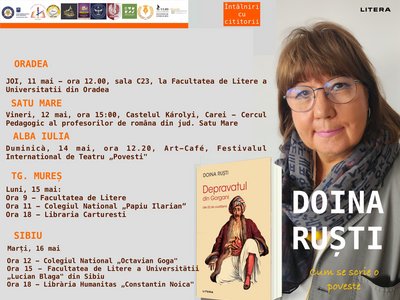
A review signed by Mircea Morariu, published on HotNews, was one of the notable critical surprises of June 1, bringing renewed attention to The Depraved Man of Gorgani: Another 52 Curiosities by Doina Ruști.
The critic evokes a Phanariot-era Bucharest permanently haunted by the fear of a new outbreak of plague — a city where the gates of houses and inns could be closed at any moment and social life suspended indefinitely. Death, Morariu notes, appears frequently throughout the book as something suspicious, enigmatic, sudden.
Within this atmosphere of instability, the characters live under the sign of excess — of deliberate immoderation adopted as a mode of existence. As Morariu writes, most of the figures inhabiting The Depraved Man of Gorgani are governed by exaggeration:
“Most of the characters live under the sign and in the spirit of excess. Of exaggeration. First of all in love, sex, and everything related to the pleasures of life — but also in theft, deception, fraud, and the obsessive desire for enrichment.”
The fifty-two stories are read as “curiosities” carefully reassembled, shaped with intelligence and humor, and guided by a clear authorial consciousness, deeply attuned to the spirit of the age. Rather than offering a museum-like reconstruction of the Phanariot world, Ruști’s prose exposes its inner tensions, contradictions, and obsessions.
Morariu’s review highlights the book’s central stake: The Depraved Man of Gorgani is not merely historical fiction, but an exploration of a society in which excess becomes a response to precariousness, and desire itself turns into a form of resistance against fear, disease, and oblivion.
👉 Read the full review on HotNews:
https://www.hotnews.ro/stiri-opinii-26302380-cronica-carte-povestiri-din-epoca-fanariotilor.htm