In an interview you *gave last year to Jurnalul Național, you mention an aunt named Lionica and her labyrinthine house, which included a room full of shoes. I would say that this is where Occult Beds (Litera, 2020) begins. What is the relationship between the reality of that room and the room of shoes in the novel?*
It is true. After speaking with Oana Portase, the small, fragile silhouette of my aunt stayed with me for a long time. Lionica in the novel resembles her to some extent, just as my experience in the room of shoes dissolved and transformed into fiction. In this sense, Jurnalul Național itself contributed to the novel, especially since my character discovers, in that room where worn shoes were stored, a bed from another time, endowed with strange properties.
When opening the book, we encounter a map covering the area from University Square to Unirii Square, labeled “Bucharest in the Dream of the Carob Tree.” Which carob tree are we talking about here? The one from The Book of Perilous Dishes?
Oh no! That was another old carob tree — tecar, as it’s called in popular speech — planted in the middle of Lipscani Square. This one is different, which was easy to imagine, given that Bucharest is full of such trees: remnants of old gardens or grown from seeds carried by the wind. As for the map, signed by Bogdan Calciu, it resulted from a walk following the traces of carob trees. This entire area was once shaded by their delicate leaves. In places, their shadows still linger, and you can almost hear the pods clinking.
At first I thought Occult Beds belonged to your Phanariot novels, but the action begins forcefully, with a murder in an apartment near Unirii Square. Why did you choose the present as the time setting?
This novel emerged from the experience of siege — it was begun during the lockdown period. It is therefore a story about a reality that was invading me at that moment. One of my memories from last autumn involves two students talking near an elevator — a girl with Asian features and a young man wearing a velvet jacket with a Byronic air. That memory became the starting point. For this reason, first and foremost, the novel can be read as a love story. At its center are two students, Florina and Lev, at the most intense moment of self-searching.
Tell me about Lev. What role does he play in the novel?
Lev is a bookseller, the owner of a small bookshop, a profession he practices with rare passion in our times. A literature student and the son of a famous actress, he could have chosen an artistic career, but he is drawn instead to old books and manuscripts. At the same time, without knowing it, he is part of a fiction born in a subtle world, beyond life and death. When a woman tells him about her former lover, invisible threads of a universal story are set in motion — an act of profound disorder that closely resembles the global situation we are currently living through.
The final part of Occult Beds is surprising: a marginal character becomes not only central but the cause of all causes. What is the thesis behind this hallucinatory ending?
This character, escaped from the harmonious world of the carob grove, is a mediocre and vain man who shakes the world. In Bucharest, apparently inexplicable events occur, which are nonetheless connected, just as information is linked in dreams — aberrantly, yet generating consequences. The universe functions metaphorically, much like the subconscious. The seemingly random mixture has its own logic; it is part of fractals invisible to the human eye. Repeated situations in life, premonitions, déjà vu, sharp intuition, symbolic coincidences, prophetic dreams — all are connected to earlier actions that have generated links, arsenals, empires. In my novel, the nodal points are beds.
The beds in the novel carry many fabulous associations. Should readers expect erotic stories? Or is the reference closer to the famous Bed of Procrustes?
I had erotic symbolism in mind, but not only that. A large part of our lives unfolds in beds, which is why their meanings are numerous. A place of rest and pleasure, the bed is also the place of dreams and death. All these meanings are present here, although narratively they are only the visible points of a mysterious geography. Florina has a map of beds — partially the very map of the novel — but each bed has traveled a long and fascinating path through time, ultimately shaping the book’s message.
Among the beds in the novel there is one described as if made for a first night of love:
“A piece like no other, a kind of king of beds, white, with a headboard climbing the wall like a flowering lilac, carved with arabesques and peacocks in full display, with flowers and leaves that seemed to be flying, fallen from the height of invisible trees, some still bearing ancient colors — muted tones of green and coral. And beneath this crested lace, in the smooth space down to the blanket, a field of snow was shining.”
(Occult Beds)
Did this bed exist in Aunt Lionica’s house?
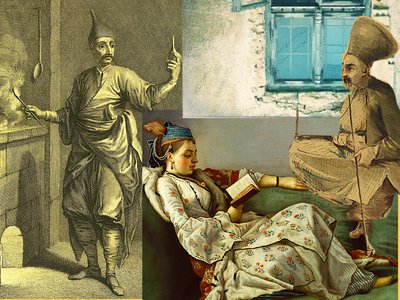
Oh no. This is a fictional bed, with an important role in the novel, but it is a bed made for lovers, sometime in the eighteenth century. Its creator is a man from Vidin, an Aromanian, married to the daughter of a money changer from Bucharest.
The story of this Valache is the most “perfumed” part of the book, found in a manuscript and enriched, expanded. How did you conceive its placement in the narrative?
Valache is nothing more than an incident between worlds, one that enlarges the stage of the collision between the two universes. His intervention does not change the trajectory of the characters; it merely gives artistic form to a certain segment of an already established itinerary.
The novel also proposes a vision of the world after death, offering a very original parable of paradise.
There is indeed such a layer, although it does not constitute the epic structure itself, but rather the context in which one of the characters evolves. Since it is part of the ending, I won’t develop it further here.
Finally, the novel can also be read as a satire, beginning with social dysfunctions and ending with the pandemic. What lies behind this intention?
There is a character in the novel who makes a case for his role in the world — he wants to be a genius, to be adored, to impose his vision of the universe on everyone — but who is, in fact, intellectually modest, petty, and entirely lacking in compassion. His insistence brings disaster upon the world. I tried to illustrate symbolically a state of affairs we have all observed over the past decades, but there was also my ironic intention to reinterpret the obsessive theme of the loss of Paradise.
All these narrative fissures intertwine into a mythical fabric, set within a real geography of today’s Bucharest, from University Square to Unirii Square, with the Russian Church as a nodal point, where a strange pianist lives. Was there a real-life model? At times one feels tempted to identify relationships with a diva or a well-known actress, between the pianist and a famous musician.
The realistic layer of the novel motivates the characters’ searches. Florina has a mother who left for Spain and remarried a man named Ramon. What troubles her is not so much the abandonment as her mother’s new condition — specifically Ramon’s goats. This suffering allows her gradual slide into metaphysical experiences. Likewise, the university environment, bookshops, the actors’ bohemia — these are the contexts of the other characters. This is where their connections and psychological motivations lie. At the same time, consciously or not, they all have access to a fantastic epic governed by the error of a wild carob tree.
The transitions from realism to the fantastic feel very natural. From a narratological point of view, what lies behind this effect?
In this novel I worked with acceptable contrasts. Lev and Florina have different concerns. Căpriceanu is perceived sometimes as a genius, sometimes as an idiot. The eunuch in Florina’s visions becomes a demon for others, while from his own perspective everything looks different. At times I used contrasts combined with insertions into social reality. Florina is a literature student, but she does not read; the basis of her culture is online searching.
“She first typed ‘slap’, then ‘he slapped her’, and ran the search. Pope Francis had lost his temper and slapped someone. Maradona slapped someone… In short, there were many slaps online — slaps in schools, especially between girls; slaps given to mistresses, to wives; slaps dealt to the economy, to a politician’s promises. Then she came across a longer text, highlighted by Google. Florina shuddered. It read, bizarrely: ‘And then Death slapped him.’”
(Occult Beds)
Despite her fragile cultural background, Florina is intelligent and gifted with a prodigious imagination. At the opposite end, Lev the bookseller is deeply immersed in books, yet just as imaginative and empathetic as Florina. Their story meets in the treacherous zone of symbolic combinations.
The structure of the novel is also interesting: fragmented, with temporal incursions, a story from the eighteenth century, and an original vision of the human condition. How will you meet your readers under current circumstances?
Only on Zoom.