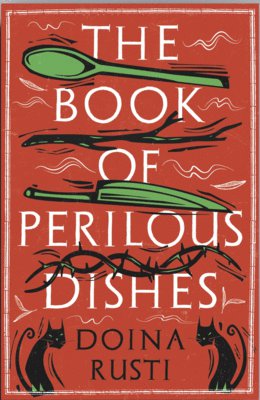
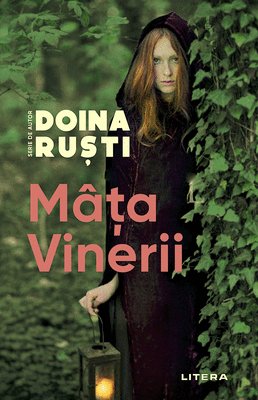
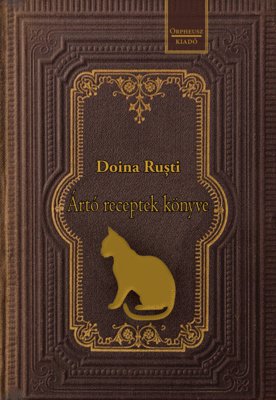
The page includes the novel’s critical reception: excerpts from studies, reviews, articles, and mentions of Mâța Vinerii / The Book of Perilous Dishes, together with references to their sources. Among those who have written about the novel are Bianca Burța-Cernat, Dan C. Mihăilescu, Marius Miheț, Simona Antohi, and Adriana Gionea. The novel has also been discussed by the Historical Novel Society and on numerous English-language literary blogs.
Critical Reception
„The Book of Perilous Dishes" a very interesting and brilliant historical fantasy. The book is translated from Romanian and I can’t wait to share my thoughts with you as it was so unique and different.
New!
Pâtca is an enterprising child, but she is also fourteen and, as she later confesses, prone to do exactly the wrong thing in a crisis. She becomes embroiled in a feud between her new guardian and the current prince over the services of a Gypsy cook with magical abilities. The cook is in possession of a copy of the dangerous Book of Perilous Dishes, whose recipes have the power to wreak havoc. Pâtca’s efforts to find her uncle’s killer and secure her inheritance take her on a wild tour of the prince’s kitchens, the local prisons, and the house of a mysterious “spiritist” named Perticari. The character of Pâtca is wonderfully delineated, and throughout Pâtca’s first-person narrative, we too are fourteen, smart, frightened, beginning to fall in love with unsuitable men, and furious a good deal of the time. I loved her.
Amanda Cockrell, Historical Novel Society
Although quite a short read ( at 260 pages ), alot is packed into this story as we step back in time seamlessly via the author’s brilliant world building and excellent descriptions of the times and places.
It's fantasy, it's folklore ish, there's witch hunts, tales of slavery and political uproar.
It's full to the brim with well fleshed out, larger than life characters, some of which are real historical figures and it's bursting with colour and the sights, sounds and smells of the time.
I did find it a little slow to start with, but the pace soon picked up and all in all, this was a real romp of a story, incredibly interesting, intricately written and I flew through this in two sittings.
Doina Rusti has a heroine who is as confused and distractible as most 14-year olds are. She is at times brilliant and at times flighty. Her emotions whirl uncontrollably. She loves and hates and loves again. She rushes to judgment then realizes she was wrong. Or was she? James Christian Brown’s translation captures, I think, the spirit of Rusti’s novel. He does not try to force it into a more American/English format. He allows it to breathe, to carry the Eastern European heart behind it. Pâtca is very identifiable and relatable as a young adult, but is also quite different in her perspective than a teenager in other places might be. Then again, I have never met an immature 18th Century occultist.
Whether Pâtca is an ordinary teenager with a vivid imagination or someone much more powerful is not immediately obvious. What is immediately obvious is that she is an intelligent and strong willed young woman, highly emotional and sometimes prone to impulsive decisions, but intriguing and beguiling all the same. There is magic in this book, and not all of it is found in the recipes.
Scintilla Info
Doina Ruști’s new book has all the ingredients of a captivating story: an abundance of fantasy, a plot woven with the sure hand of a storyteller who knows how to entice the reader, an atmosphere so powerful that it lingers long after the book is closed, and—last but not least—a subtext that points toward the mysteries of the World and of Literature. Unfolding its events on the border between magic and the fantastic, in the picturesque setting of Bucharest around the year 1800 (used, in fact, as a pretext for a narrative that transcends the limits of a historically documentable framework), The Book of Perilous Dishes dreamily outlines the boundaries of a fictional universe in which, in carefully balanced doses—like in an alchemist’s alembic—the deceptive substances of reality mingle with the vivid matter of an unreality (or surreality) erupting into everyday life. Merchants, witches, spiritists, cooks from the princely court, lovers, pretentious young ladies, ambassadors from distant lands, arnauts, officials of the Sublime Porte, deposed princes and newly enthroned rulers, schemers of every kind, revolutionaries, Bonapartists, conjurers, and envoys of Sator populate the carnivalesque space of this fantastic novel, whose underground passages lead far away, toward barely glimpsed worlds.
Bianca Burța Cernat, Observator cultural
The Book of Perilous Dishes — a stylistic jubilation, a vital literature, like Süskind’s Perfume up to a point and Vodolazkin’s Laurus from another point onward.
Dan C. Mihăilescu, Humanitas Cișmigiu, video
The Book of Perilous Dishes is catchy. It begins abruptly, and the narrative tension never slackens until the end.
The Book of Perilous Dishes is a kind of Mysteries of Bucharest in a Phanariot setting, gaining through the novelty of its perspective.
Marius Miheț, România literară
You feel as if, on our streets, a witty storyteller has met the Phanariot version of Salman Rushdie.
Much has been written about the Phanariot period and the legends that swarmed through its Bucharest, but no one today has dared to revive the appetite for the fabulous, for picturesque and mischievous inventions, or for stories drawn from sensational facts with a hallucinatory core, as Doina Ruști does. Readers enchanted by the pages of The Phanariot Manuscript can rest easy! The new novel, The Book of Perilous Dishes, preserves the same recipe that blends historical sources, eccentric details, and unusual infamies recorded in documents. These are mixed and left to marinate in a vessel of facts reminiscent of dense reading, in which abundant storytelling expands once infused with magical realism drawn from the world of superstition, spirits, and witchcraft hovering over the banks of the Dâmbovița.
Adriana Gionea, Postmodern
The Book of Perilous Dishes, a narrative of witchcraft, occult gastronomy, and mystery, ultimately proves to be a seductive initiation novel. The captivating storytelling of adventures, matured through suspense, combines with sensual writing seasoned with oriental spices—the work of a sorceress of words. Doina Ruști’s book is a literary delicacy conceived according to a hybrid, ingenious recipe with old and new flavors.
Gabriela Gheorghișor, Ramuri
Doina Ruști’s novel brings us close to fascinating ghosts of the past, and their captivating stories draw us into an irresistibly tempting culinary-magical universe. It is a pity that some ingredients remain unspoken—that silence which so sublimely covers times long gone and without which they would not be so enticing for us today.
Andreea Iulia Toma, BookHub
The Book of Perilous Dishes is a fantasy novel that could become a highly successful film, yet also a book that recreates a unique world described by late chroniclers and pamphleteers of the time.
Cațavencii, no. 19, May 17–23, 2017
Cristian Teodorescu, Cațavencii
A gourmand of both visible and barely guessed meanings, Doina Ruști writes a sensational novel that excites sight, hearing, smell, touch—and, above all, taste, with spell-like delight. A delectable book that—both literally and figuratively—makes your mouth water.
Petru Țincoca, BookHub
http://www.suplimentuldecultura.ro/index.php/continutArticolNrIdent/Avanpremiera/12008
Suplimentul de cultură
A good book, a bildungsroman set in an imaginary Wallachia, anchored in the illusion of a historical novel through its many references to real historical figures. But I know better—The Book of Perilous Dishes is a beautiful lie.
Eduard Pandele, BookReport
Through her exceptional prose, the writer transforms an urban legend into a fascinating story.
Anastasia Fuioagă, Alecart
The Book of Perilous Dishes is a book in which plausible, documentary-like information and fantasy blend organically throughout the epic scenario (generously offered to the reader, whoever they may be), forming a delightful narrative whole situated at the border between reality and dream, or between story and reality.
Mioara Bahna, rev. Argeș, October 2017
It is not only about the princely kitchen ruled by a cook stolen from Greceanca; it is about a world whose tragedy hides behind the violent colors worn by clothes and behind words that often convey ineffable states that only a great novelist can reveal.
Everything Doina Ruști writes is an act of faith—assumed like that of a great novelist.
Constantin Dram, Convorbiri literare, October 2017
The Book of Perilous Dishes has a special bucolic charm, creating a fairy-like vision in which historicism and sentiment intertwine in a beautifully pastel tableau illuminated by Doina Ruști’s exuberant skill, casting an angelic light on the Phanariot era.
The interior and exterior descriptiveness of events unfolding impulsively between myth and reality overlays the inner labyrinth of feeling in dazzling colors, woven with stormy romanticism and intricate architectures of the senses, sketching a world at times jagged yet contagious, insinuating, and enveloping.
Cristian Cărpenaru, Book.Nation.ro
I recommend this book to those who read fiction, to those who want a strange blend of beautifully intertwined stories full of mystery, and to those who enjoy gripping plots that hook you from the first moment and never let go. When I finished it, I was amazed by the ending—it was not what I expected. read
Miss Shady
This is the kind of book I love, especially because of its relatively static plot, the absence of purely good or purely evil characters (even the seemingly positive protagonist tried to poison someone), and above all the descriptions of dishes—most likely imaginary—whose ingredients even Google could not clarify, yet sounded wonderfully appetizing.
Laura Frunză, blog
A historical novel full of atmosphere read
Ivona Maris, În mansardă
The fictional-gastronomic code in the novel Mâța Vinerii perfectly coexists with the literary revival of Phanariot dynasties. Like a true and experienced archaeologist, Doina Ruști unveils and reconstructs the history of a magical recipe guide and that of the followers of an obscure divinity called Sator. In this historical fiction, the two overlapping codes generate the illusion of parallel—or alternative—worlds, in which factual reality is doubled by a magical-mystical dimension where Sator and his followers often use gastronomic tools to coordinate the world.
Simona ANTOFI
Passion, mystery, the fog of an autumn night, the beautifully lit suburb, memories of Leipzig houses where the heroine’s parents were struck down by plague, the waters of memory, the Satorians, the midday sleep “full of dreams and pleasures,” and much more compose the story in a baroque… Balzacian… postmodern novel.
Grațiela Popescu, Caiete critice, 10 (372) / 2018
The novel’s construction follows the labyrinthine structure of the protagonist’s memories—on an identity level, through blood ties to the Satorians revealed only at the end; on a magical level, through the props of a world of deceptive mirrors, illusion and constant change, hidden meanings and initiates (recipe books, spells, elixirs and passwords, manipulated dreams and tricks, forbidden books); and on a political level, through Pâtcă’s efforts, whose futility turns her into “an Alice without a compass in the land of Balkan magic.”
Above all, the true protagonist is language itself, from which a genuine spectacle is created. The writer blends archaic and contemporary words to reconstruct the era, while the text’s comparisons and metaphors arise from surprising juxtapositions: time squeezes events “like sheets hung out in the sun,” and noon is “a honey cat walking through Pâtcă’s soul.”
This is a book that I would recommend to those who enjoy literary fiction that does not keep rigidly to a timeline and who could cope with the magical realism aspects of the narrative. Whilst this may not be a novel for everyone, I enjoyed it and am glad that I read it.
The translation here is extremely well-done, but it’s the story that shines with a beautiful use of language, a fascinating plot, and characters who are by turns terrible, silly, and enchanting people. Patca and Caterina are especially wonderful, although Cuviosu and Maxima piqued my curiosity as well.
Ruști creates a Bucharest that is enthralling and captivating as she blurs the lines between fantasy and historical fiction. With Patca as guide, the city’s whimsical warrens and mystical machinations provide fantastical fodder for its people. Sure, the curiously fluid timeline of The Book of Perilous Dishes can lead to misdirection and misunderstanding, but that might be the point. If nothing is ever as it seems, then you must respect every possible detail, no matter now fleeting. Cooking can be a lot like writing: it tells you about the environment you’re in through the details of a recipe or story, especially when you engage in the delicate art of stylistic fusion.
Ruști’s writing excels in her descriptions of food, surroundings, clothes, appearances, and more. It’s extremely tactile: you can sense the environment and actions, from feeling the swirls of cloth and tasting the dishes to following the action as it flows throughout the streets, markets, and homes of Bucharest. Ruști also imbues Patca with a precocious fusion of childlike wonder and world-weary mysticism. Our main character has been forced to mature a bit quickly, but she still retains an innocence about the machinations of the grownups in her world.
See also Critical Reception
and [BIBLIOGRAPHY]