From the perspective of narrative technique, the novel is a jewel in which the author slips, without ostentation, into the skin of each character, the result being a refined psychological and contextual analysis.
From Zogru to Mommy of Two Cornflowers, Doina Ruști demonstrates the abilities of a complex, necessary and memorable writer. We are talking about the absence of literary excess, about meticulously constructed texts and an impeccable dosage of details, of useful frivolity and of essential questions.
Andreea Banciu, Good Signs
Doina Ruști applies to the narrative an optical filter as fresh as it is close to social-political reality, a filter of observation from beyond events. Mommy of Two Cornflowers is the euphemism under which hides the identity of Geta, the enigmatic correspondent of the prime minister himself. Her “cornflowers” embody a way of relating to others, a perverse form of manipulation, concealing a diabolical, egocentric psyche. Suddenly, the banal character is no longer quite so banal (...)
Mommy of Two Cornflowers remains a novel of the present, with an unexpected epic resolution and a very good socio-political placement.
Monica GROSU, November–December, in Luceafărulno. 11–12
Doina Ruști is the kind of prose writer you simply cannot dislike. Her prose speaks the language of today’s reader, in Romania of the year 2013. And the subjects she chooses cannot leave even the most disinterested reader indifferent. If until this novel the above could only be intuited, with Mommy of Two Cornflowers it will be clear, I believe, to anyone why Doina Ruști’s books have enjoyed such great success so far. Here we find, in an almost declarative form, the author’s long-standing intention: to use immediate reality as a source of inspiration — and to build upon it, subtly and naturally, as all great prose writers of their time have done, subjects with universal or universalizing meanings. This is not easy; the specter of falseness or strain lurks everywhere. Doina Ruști succeeds brilliantly.
Mircea PRICĂJAN, June 2013, in Familia
Mommy of Two Cornflowers brings a story about an artificial family, created by virtue of old conventions belonging to a dead world. [...] It is a book that consolidates aesthetic beliefs: it is my only book with authorial rhetoric (of a certain type). It was a very important experiment for me. At the same time, it was my way of getting through the many events of last summer, when I could no longer step out into the world without hearing something disturbing: TVR Cultural shut down, the Romanian Cultural Institute moved under the Senate, referendum, sailors, changing laws, plagiarism, the privatization of Oltchim, etc. Sometimes you must do more than comment on newspaper websites. For example, write a book.
Doina RUȘTI in interview with Stelian TURLEA, May 31, 2013, in Ziarul de duminică, no. 21
The development of the plot and characters holds many surprises for readers. None of the heroes is exactly what they seem at the beginning, and the past revealed gradually not only to readers but also to the main character is not what it first appeared to be. More generally, Mommy of Two Cornflowers can also be read as the story of the implosion of a family unit built on appearances and lacking the emotional bond needed to withstand the pressures of a world that, in many respects, has gone mad.
Dan Romașcanu, May 28, 2013, on filme-carti.ro
The novel is a chronicle of that summer of crisis. Of course, it is not about a real political figure. The novel treats the theme of authority, illustrated by real or imagined parents, but also by a prime minister just as confused as any other authority in times of crisis. I have read comments about the character-prototype relationship, arguing that novels fictionalizing the present do not endure. I believe a writer must write about their time. With the passing of years, no one will make any connection between my character and Victor Ponta.
Doina RUȘTI in interview with Andreea BANCIU, January 28, 2014, on semnebune.ro
From the perspective of narrative technique, the novel is a jewel in which the author slips without ostentation into the skin of each character, the result being a refined psychological and contextual analysis. (...) From Zogru to Mommy of Two Cornflowers, Doina Ruști demonstrates the abilities of a complex, necessary and memorable writer. We are talking about the absence of literary excess, meticulously constructed texts and an impeccable dosage of details, useful frivolity and essential questions.
Andreea BANCIU, December 25, 2013, on semnebune.ro
In this book, the structure is also innovative: the way several seemingly unrelated stories develop in parallel, in successive chapters.
Lorena LUPU, May 24, 2013, in Tabu
With a steady hand, Doina Ruști takes us through the streets of a Bucharest that at first glance seems normal. But she also guides us through the complicated alleys of the soul, where it is easier to get lost than you might imagine. Impartial both toward Dâmbovița politics and the politics of the heart, the narrator’s voice describes the world we live in and in which, somehow, we still manage to love. Knowing what this world is like, the ending should not surprise us. And yet it does — and how.
Florin IRIMIA, March 23, 2013, in Suplimentul de cultură, no. 392
Mommy… is a book written with nerve [...] with plenty of surprising narrative marrow that gives satisfaction in reading.
Wilkins MICAWBER, April 23, 2013, on ce-am-mai-citit.blogspot.ro
It is a great gain when an already canonical writer chooses to emphasize simplicity and clarity over philosophical tirades, boring incidents and tangled phraseology.
Felix NICOLAU, June 21, 2013, in Ziarul de duminică
What Cristi Mungiu’s boys do in Romanian cinema, she executes single-handedly in literature. The subjects burn, the characters draw inspiration from the decrepitude of the times, the banal becomes a Dantesque casting.
Marius GHILEZAN, April 17, 2013, bookiseala.ro
Mommy of Two Cornflowers by Doina Ruști is an excellent novel of our times. A book of everyday spectacle, which we swallow willingly or not, behind which stretches a vast existential void. A sad book of a perverted world, from which the joy of life has disappeared and in which people walk with heads bowed, crushed by the lack of perspective they feel in these dramatic times. A book of vague à l’âme in which every reader will surely recognize smaller or larger parts of their own existence.
Tudorel URIAN, October 16, 2013, in Viața Româneascăno. 7–8
In Mommy of Two Cornflowers, Doina Ruști composes in a single breath a good book on an older theme of her prose: the demonic, vengeful child. Attentive to the spirit of the times, she works especially with “recycled material”: tabloid news, the buzzing siege of SMS messages, Facebook as game and perverse game, the mall world, all consumed bulimically and mechanically thrown away. The atmosphere suits the author perfectly, who quickly finds three strong characters, one weak, plus one failed (but marginal) to turn a few months of their lives inside out and reveal the filth, egoism, cold ambition and failure underneath.
Tania RADU, March 13, 2013, Revista 22
For several years now I have passionately followed everything that appears under the name Doina Ruști. I have just closed the latest novel, fresh, fresh, Mommy of Two Cornflowers. Bach and flamenco provide the book’s soundtrack.
Cristina ISAL, March 1, 2013, pravaliaculturala.ro
Mommy of Two Cornflowers is a novel you read breathlessly, a surprise novel that leaves you at the end with the slightly bitter taste that it ended too soon… A book about our days, but also about the history of a human being in permanent search of that “something else”. The ending is so well orchestrated narratively that you feel it slipping through your fingers.
Andra TISCHER PODIA, on Facebook
The Dissolution of Authority
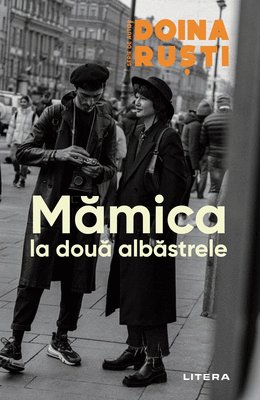
Doina Ruști, Mommy of Two Cornflowers, 2nd edition, Litera 2024, author series.
Recently I received the critical edition of the novel Mommy of Two Cornflowers, which I reread and discovered new things. It is the sixth novel in the author series, in an elegant editorial form, prefaced by Andreea Banciu and accompanied by critical selections signed by Marius Miheț, Dan Romașcanu, Florin Irimia, Marius Ghilezan, Tania Radu, Tudorel Urian, Andra Tischer and many others, including myself.
This novel, about which I have written less, takes you into a familiar atmosphere, with characters and events recorded by history. But do not expect theories or moralizing dialogues or the unraveling of conspiracies: the whole story, although anchored in an undeniable present, unfolds cinematographically, focused on a love story perfectly suited to the mentalities of a drifting world.
The message grows progressively, from a story as banal as it is powerful.
The main character is None, a cameraman from Romania’s middle class who at first glance seems mediocre, with ready-made judgments and cultural pretensions. He condemns parents who abandon their children, hates manele music and is a convinced family man. He adopts a child because he is a “good” man. Yet his life is so fragile that at the first blow everything collapses.
The story is set against a precisely defined social background, during the sale of Oltchim, when the world had grown tired of Băsescu and politicians fought for power. Against this background, the prime minister (a fictional character) receives a Facebook message from someone signing as Mommy of Two Cornflowers.
Parallel to the prime minister’s life, told in flashes, we have None’s story, who sees everything cinematographically, as if through a camera connected to his brain — a vision that quickly becomes a channel between family life in a modest apartment block and the unexpressed aspirations of this man, modest in daily life yet impetuous in his dreams.
What differentiates this novel from the thousands of quasi-literary accounts of the Romanian family is the power to reconstruct simultaneously each character’s inner world and the social world.
None, a being with traditional principles, is endowed with prodigious imagination and psychological acuity, qualities leading to unparalleled metamorphoses. Entering an almost deserted school, he reconstructs a teacher’s past actions from details. Looking through his camera lens, he searches for secrets in grimaces, lips and eyelids. When someone tells him about a funeral, he processes the information filmically:
“A day in May, with fifty people at the cemetery… Two frames of muddy shoes flashed under his eyelids…”
His investigation leads to the revaluation of his own father, abandonment and the fragile parts of family life, gradually leading to his mother, the prime minister’s secret correspondent.
Many narrative steps build toward a truly unexpected ending.
This is not satire, though it extracts material from the world we live in. Every detail feels perfectly placed. Nothing is superfluous. Everything is absolutely new, from style to subject.
Ultimately, the novel is about “defective authority,” as Doina Ruști states in an interview. It courageously raises the issue of family and its tacitly accepted oppressions. None himself is an authority; the prime minister is symbolic authority; the mother, teacher and Mommy of Two Cornflowers are parts of an authority in decay.
The novel becomes a history of inner revolt projected across multiple forms of authority. The love story is an episode of escape — a confirmation of the human ideal: to be master of your life or, as the novel says, to have the freedom to “cross the street just to kiss Nini.”
A novel with many layers of reception, written as if in a single breath, convincing and with a universal message, Mommy of Two Cornflowers is a book of true literature.
Adriana IRIMESCU, Bel-Esprit
A volume that not only kept me captive on every page, but here and there moved me enough to bring many tears.
Zâmbetania
The novel makes you wonder whether we live in a society in which we are spectators to the bankruptcy of the familyin its traditional form. If I have made you even slightly curious, give this book a chance. Below I leave an interview with the author that made me look at her novels with great curiosity and gratitude (we also need authors who write about the dark side of life, because whether we like it or not, love and family can easily turn into toxic and unhealthy refuges).
See also Critical Reception
and [BIBLIOGRAPHY]


