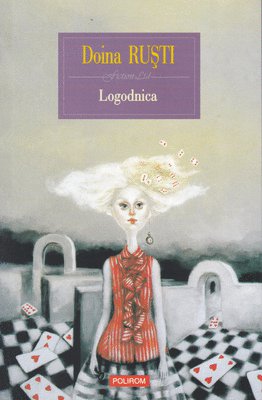
David Kinsella is a British director based in Norway. In fact, by blood he is Irish—full of passion, like all devotees of Saint Patrick—yet he chose to temper his fiery temperament in quiet, calm Norway, which adopted him. A successful director, David is also connected to Romania, where he has many friends who know his life and passions. And one of these passions he wanted turned into a book. Without hesitation, my thoughts went to Doina Ruști, the mistress of words and of stories that fascinate you. Like all of us, David too was won over by her narrative charm and asked her to write his love story. Sometimes someone else can see better than you the hidden keys in a series of events. Yet this was not David’s main reason. He wanted to experience the condition of a character—to feel on his own skin the spectator’s merciless eyes. Of course, he imagined that Doina would follow the facts he himself had confessed to her—something impossible, given her extraordinary originality. “What kind of story is that,” she asked, “told in a single voice? Any love presupposes a HE and a SHE—two points of view.” Therefore, Doina wrote an admirable novel, built from two confessions, as different as they are inseparably bound.
Written in three months, the novel The Fiancée brings not only David’s love story, but also a parable about East and West, about Europe’s extremes.
Dan Burlac
Doina Ruști has the rare ability to capture the hypocrisy of individuals and of society in the most inoffensive forms—yet beneath the slow unfolding of the plot, these forms have a constant erosive function. A pictorial kind of writing (through perfectly used comparison) and cinematic in its breadth.
Ramón Acín
If you are a Western reader, you will see a splendid exotic novel. If you are from Eastern Europe, you will also perceive its depth—the reflection on completely different worlds, on the upheavals of recent history, which the novelist uses to bring to life characters that are vivid, yet burdened by a tragic condition.
The unpredictable nature of human beings is very well harnessed: Alisa, “the fiancée,” is the illusion of David’s life. The woman never truly possessed, the woman-as-obsession whom—even when he knows she has taken advantage of him—he would still want in exchange for the whole world. Nor is the “profiteer” an idiot: proof is that she sincerely calls him an “angel,” and for a few seconds we have the impression of a parody after Dostoevsky.
Here lies Doina Ruști’s irresistible force. She tells us a story that is closely tied to the reality around us; she makes us dream of famous books; she amuses us and makes us think; she shows us where the cultivation of the chaos of contemporary life can lead—chaos amplified by the Internet’s powers to communicate and to expose; she surprises us with subtleties that go beyond narrative frames and the commonplaces familiar to those who have read a great deal of literature. The Fiancée is a reading experience that makes you want more—more stories, Ruști-brand.
Serenela Ghițeanu, revista 22, 10 Oct 2017
The Fiancée is a book about the human—about too much human, to be Nietzschean ourselves—another kind of Russian woman who has found another kind of Gib I. Mihăiescu… A Russian woman of ours, of us Romanians!
Adi George Secara, BookHUB
In a cinematic rhythm, the two confessions function as bitter emblems of an organic incompatibility of culture, mindset, thrill, burning, empathy, horizon of expectation, traumatic baggage—things that make the success of a melodious dynamic of love between the two confessors impossible. So structurally opposed, so different in attitude, inner construction, and the metastases of suffering, that the stories of the two actors do nothing but deepen the chasm between them, denouncing, one by one, the stereotypes, taboos, and prejudices of each world. Doina Ruști’s book resembles a tango—the dance of love, betrayal, passionate expectancy, falling, mystification and, respectively, demystification; here, the dance of an absence of chemistry between partners, of a specter obsessively fed by stimuli wrongly interpreted by David, of an aspiration toward the free circulation of dreams coagulated by the chimera of the West—an aspiration in whose arrest Alisa seems cursed to pause, endlessly.
Ioana Cistelecan, Familia
Alisa’s novel is painful, tragic, yet alive—true, colorful, multi-thematic and often poetic. David is not an innocent; he is not a victim: he casts a net (of dependence), and she is not a woman entirely lost, not venal, but an orphan who must survive, who must always fight, who has nothing certain (and therefore lives always in the moment), in a society where it is easier to sell yourself than to find your chance. He has the comfort, morality, and superiority of a secure life; she has the desperation and amoralism of one who cannot rely on anything, living in a real jungle.
Alisa sends you to Chira Chiralina, to Manon Lescaut, Marguerite Gautier, Marion Delorme, Esther Gobseck—fallen women but with noble souls, whom their creators rehabilitate by purifying them through love.
Laurențiu Ciprian Tudor — REVISTA LITERARĂ LIBRIS, Year I, no. 4, December 2017
Doina Ruști turns the female character into “a metaphor for the world we live in, for the East,” and deconstructs the image of the Western mirage. The novel captures not only a love story, but diametrically opposed worlds; it reveals social aspects of the Republic of Moldova, as well as a current global phenomenon with major social implications: Facebook, which has become an instrument for manipulation and mystification of reality (fictional people and posts, incitement to revolt, paid smear campaigns, influencing elections).
Doina Ruști looks deeply into contemporary society in the era of globalization; she sees beyond appearances the hidden face of the real; she exposes, in fiction, the dramas of today’s world, the psychological and social mechanisms in which the individual is caught like in a net. The narration is dynamic, the vision cinematic, the characters and language very much alive.
Sonia Elvireanu, Convorbiri literare, Nov 2018
The story of the two protagonists recalls the one presented by Mario Vargas Llosa in his famous novel, The Bad Girl. Beyond the ubiquitous subject in world literature—the woman who marks your life—The Fiancée also stands out by highlighting both the difference between Eastern and Western mentalities and the antithesis between the madness of youth and the desire for stability in maturity.
Monica Macedonski, DCNews
A true story about love and revenge.
See also Critical Reception
and [BIBLIOGRAPHY]
Un Cristian, Observator cultural


