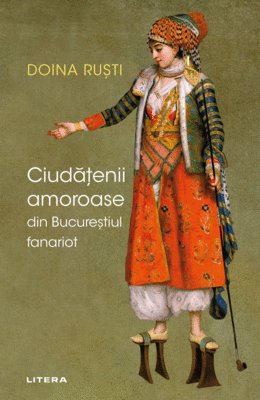
“Phanariot Bucharest is a city that rocks day and night to the soporific rhythm of manele, steeped in the smoke of long pipes, in superstitions, rumors, and magical Oriental aromas, and that, from time to time, allows itself to be assailed by endemic, purposeless frenzies, by heavy sadnesses and nameless melancholies.
If that were all, it would still be enough.
But the stories Doina Ruști tells us—about impossible loves, grounded in documents and written with her well-known talent—lift the curtain on a world of customs, merciless private relations, surprising behaviors, and strange habits.”
Eugen NEGRICI
Eugen Negrici, back cover (fourth cover)
Out of the 47 stories, each one is more fascinating than the last. It is very hard to choose: each has a certain something that seduces you and makes you stand by the main character with real sympathy. Doina Ruști loves her heroes, and that explains the way she understands their world. Otherwise, the world of two hundred years ago would have remained mysterious to the reader: our contemporary reference points of every kind are completely different, and without the writer’s empathy we would not come to marvel at her heroes.
Serenela Ghițeanu, Revista 22
“Love Oddities from Phanariot Bucharest” is a splendid volume of 47 stories in which the author weaves a lacework of true happenings, spicy historical details, and tiny fictional additions, based on 18th-century documents. Doina Ruști’s epic ability to incarnate herself in Phanariot aesthetics needs no presentation; her Süskind-like metempsychoses are genuine master classes in documentary reconstruction. And that makes me think of something a character in Thornton Wilder’s The Eighth Day says: “Imagination is when you see through a wall.” Here, imagination is when you see clearly through monographs and princely deeds and know how to blow over them a revelatory film.
Liviu G. Stan, Cultura
Probably most of the readers of this column—if not the majority, indeed the great majority—cannot even imagine what a fabulous, wonderful, astonishing, perfumed and seductive world existed two centuries ago (and a bit more) in our Bucharest—and, more broadly, across Wallachia and Moldavia. Not only enchanting, colorful garments, with names almost forgotten today yet still alluring to the ear; not only surprising customs, laws we can barely understand today; not only houses and roads that seem primitive to us but were modern in their time, compared with what had existed before; but above all stories—histories that can leave you open-mouthed. True novelistic subjects. Some Doina Ruști has already locked into a few of her novels from past years. But most remained unwritten.
Until the book we are noting today—a jewel in every respect.
Doina Ruști’s book brings together a series of happenings woven around amorous intrigues unfolding in Phanariot Bucharest at the end of the 18th century.
The narrative techniques and the subjective imagination of this story collection bring to mind the torrid, erotic nuances of Klimt’s paintings, the floating silhouettes of Chagall, the transfigured reality in Dalí, the bittersweet histories in Ian McEwan’s books, the force with which Alexandru Vona or Gellu Naum re-semantized the world through text, the realities retold with meaning in Imaginary Deaths by Michel Schneider. In other words, in Doina Ruști’s volume we have a world in shalwars and ișlic, cut out from the desert of the real and retold in the way she herself, without a doubt, would most have liked to read it.
Iulia Micu, Litera
The 47 stories drew my attention especially through the narrative model—diverse and modern—which makes me begin with the story Narcis’s Clan, where, from the very first paragraphs, we notice the intertextual relationship with Doina Ruști’s debut novel, The Little Red Man. What interests us above all is the shift from the recollection of an autobiographical episode to the most truthful description of the tableau which—although we see it, since almost every story enjoys an illustration from the period—we do not feel as the author does. We do not feel the alagea (cloth) of the anteriu; we do not suspect that white fabric was not much worn because it was hard to maintain; nor do we think that the mustachioed Aredio Sochim’s outfit is one for special occasions. We decipher his charm from the deep gaze that targets us directly, but we do not feel even a tenth of the subject’s “acute desire” not to be forgotten, to be truly looked at—meaning analyzed—as a “face with pretensions and hopes,” for “to have your photograph taken is, in the end, a rather strange love, exactly like when you write a novel and talk about yourself.”
An anatomy of the narcissism that haunts any creator, Sochim’s portrait gradually turns into a subtle caricature.
We cannot fail to notice that every fragment of strange story captured by Doina Ruști has as its starting point real, true happenings, recorded in old documents preserved in archives, museums and libraries. Only the author’s introspective eye and her writerly talent make lines written dryly on yellowed scraps of paper capable of bringing into the foreground faces and garments, morals and amorous oddities from the Phanariot Bucharest landscape. In addition, the wonderful strange stories told by Doina Ruști across these 175 pages are contained in an exceptional editorial achievement, on vellum paper, with splendid color reproductions of paintings of the period.
Doina Ruști, with an imagination perfectly fitted to the Phanariot space and time, creates tales of a world and an atmosphere that are passionate, enchanting, and credible for the 21st-century reader.
Delia Marc, filme-cărți.ro
The subjects are, more often than not, bewildering: murders and poetry intertwined with the history of the Văcărescu family of poets, the madness of a German named… Voicu, clandestine affairs at the Palace, a servant who becomes, through literature, “a minor immortal,” two young devils who fall desperately in love with a woman, the plague arriving alongside black storks, a princely official who falls under the spell of the iele (supernatural female beings in Romanian folklore), farmhands who rise above their social station, unusual sensations and passions, deceptions, murders, broken oaths demanding judgment by the Phanariot ruler, poisonings, acts of revenge, customs and laws, punishments administered with sticks to the soles of the feet, countless period scenes and an extraordinary wealth of detail. All this unfolds in a world about which we know next to nothing, yet which, after reading Doina Ruști’s book—or books—we come to believe was inhabited by people who loved until they were utterly intoxicated by dreams, pleasure, and beauty, whether real or imagined, and who not infrequently paid for their desires with their lives.
There are also two unconventional stories. One is entitled The Farmhand’s Testimony (Mărturia argatului) and recalls a Dostoevskian text in the way the narrator deliberates over what might happen to certain characters: “What can be done with these characters? There is always a conflict, either an open one—in which, for instance, two characters encounter a third who puts up increasingly strong resistance—or a conflict dispersed across small narratives that tell us things about their earlier lives…”
The other story is The Horse (Calul), in which the central figure is no longer human: “He was a remarkable animal, more than that, a true companion. One night, he thought he saw the horse at the window, snorting knowingly. There were days when, no matter what he said, he would cast a glance at the horse to make sure it approved.”
As I have already suggested, beyond everything and everyone else, Phanariot Bucharest is the one great character. Yet the “stories,” told with passion and literary flair by a narrator deeply enamoured of her subject, allow these characters—many of them enjoying an original kind of “democracy” that overturns the conventional logic of literary “heroes”—to join the ranks of the “immortals” through the power of genuine literature.
And, inevitably, novels follow.
Constantin Dram, Convorbiri literare, No. 11, November 2024
A turbulent, subtle, surprising eros—such as, probably, all love stories worthy of remaining in literary memory.
There are human beings with occult openings, with the power to transcend reality, and Mrs. Doina Ruști is certainly such a being. Almost unreal. That is why it is easy for her to draw aside the curtain that covers the past.
She won me over.
Gina Varga, Bel Esprit
The world of “Love Oddities” is one of desires, senses, and passions—a powerfully colored and perfumed world where people, intoxicated by dreams and beauty, commit unheard-of deeds. Murders, thefts, poisonings, complaints, revenge, rivalries, and deceptions of all kinds show how that world functioned, how people thought, what set them apart and what brought them together, what their beliefs and desires were, what the laws and punishments were.
Doina Ruști’s stories are detailed tableaux reflecting the fashion of the time (anteriu, ișlic, marten coat, sable or fox, cashmere shawl), and Romanians’ fascination with objects, spices, fabrics, and silks brought from abroad.
See also Critical Reception
and BIBLIOGRAPHY


